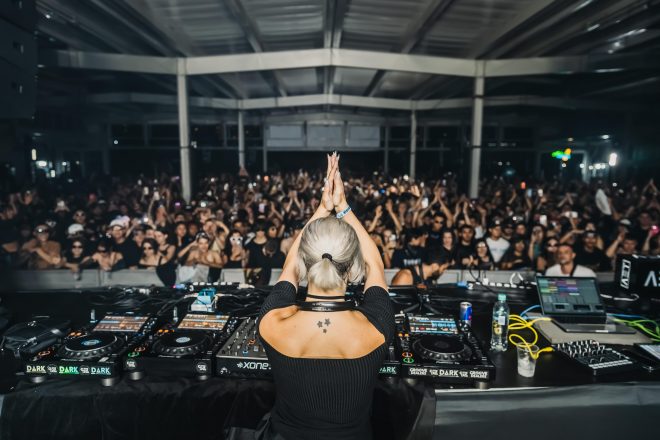
PERT: THE DISTANCE BETWEEN BELONGING AND BECOMING

For Pert, the journey from Argentina’s underground to international dancefloors has gradually become a question of identity rather than geography. Through music, GRUVALISMO and Sinapsis, she explores the relationship between personal freedom and collective responsibility, finding meaning not only in the spaces she reaches, but in those she helps create.
Distance can become a way of seeing yourself. It can make certain places appear larger than they are, turn recognition into something almost mythical and convince you that the most important things are happening somewhere else. For Pert, growing up within Argentina’s electronic music culture meant looking towards Europe with admiration, but also confronting the uncomfortable question that comes with ambition: what happens when the world you want to enter seems to exist so far beyond your reach?
For years, Europe represented possibility. Its clubs, artists and established musical communities occupied a place in her imagination. Yet the distance that initially made those spaces feel inaccessible eventually forced a more important consideration. Reaching them would mean little without understanding what she wanted to express once she arrived.
“I don’t know if I ever thought of it as finally ‘belonging’. What became more important to me was realizing that I could contribute something from my own identity. At some point, Europe stopped being just a dream and I started turning it into concrete goals.”
There is something revealing in her refusal to describe that journey through belonging. The word suggests acceptance into an existing order, as though an artist’s identity becomes legitimate only once recognised elsewhere. Pert’s experience gradually led her away from that idea.
“Argentina gave me resilience, focus, consistency and a strong sense of self-worth. Today I feel that my identity is very solid, both in my sets and in my productions, and it is deeply Argentine. Not necessarily because there is an obvious Argentine sound in every track, but because of the way I approach everything: with intensity, passion and, above all, love.”
Her sense of origin is not something she needs to demonstrate through musical references. It exists in her behaviour, in the decisions she makes and in the persistence required to sustain them.

THE EXPERIENCE OF LOSING TIME
There is a curious contradiction at the centre of electronic music. DJs spend their performances measuring time with extraordinary precision, yet some of their most meaningful moments occur when the audience stops noticing its passage. Her approach to DJing is built around the relationship between movement and perception. Groove provides the physical foundation, while layering and gradual transformations create an environment in which the listener’s attention can move beyond individual tracks. Working frequently across three decks, she constructs sequences that change almost imperceptibly. The objective is not constant escalation, but a more complex relationship with intensity.
“For me, hypnosis has a lot to do with losing track of time. I like working with a lot of layering, often across three decks, building different elements on top of each other and gradually changing the perception of the set.”
That understanding has developed through very different dancefloors. A seven-hour performance at Under Club in Buenos Aires taught her how patience can become a creative instrument. Playing vinyl alongside Hector Oaks and Phil Berg in Slovenia required another form of concentration, where selection and continuity carried particular weight. At Aerotechno Festival in Medellín, performing for more than 3,000 people demanded an ability to preserve connection across a larger physical space.
Each experience complicated her understanding of what a DJ can control. A room has its own history before the first record begins. The previous artist has already established a direction. The audience arrives carrying expectations, fatigue, curiosity and varying degrees of willingness to surrender to the music.
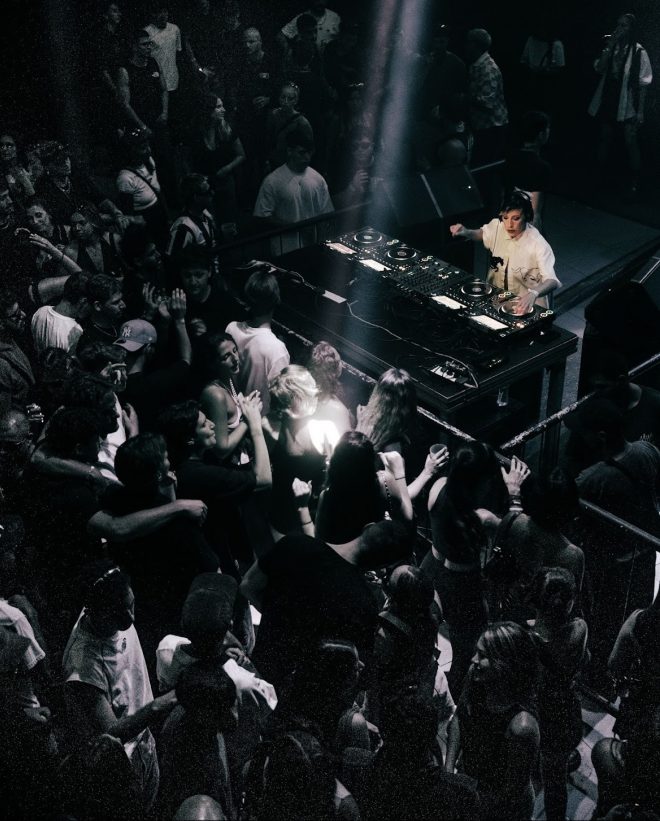
“I always prepare a lot of music with the specific event in mind, but once I start playing, the set becomes completely about the exchange with the crowd. For me it has to be a conversation. I’m constantly reading what comes back from the room and deciding where to take it next.”
Perhaps the most interesting aspect of that conversation is its unpredictability. A DJ can propose a direction, but cannot determine how it will be received. The audience participates in shaping the experience, even when the decisions behind the decks remain invisible.
She allows intensity to recede, introduces more introspective passages and sometimes builds a warm-up within her own set. Rather than treating the dancefloor as a space that must remain permanently stimulated, she approaches it as an environment capable of holding different emotional states.
“I want the dancefloor to be truly present, in body and mind, each person inside their own journey. If I can make people forget about time for a while and become completely immersed in the present, then something special is happening.”
THE FREEDOM TO KEEP LEARNING
Confidence is often mistaken for the absence of doubt. Pert’s experience suggests something less straightforward.
Over time, performing in unfamiliar environments has given her greater certainty about her artistic decisions. Yet that certainty has not removed her desire to place herself in situations where she must learn again.
Her increasing use of vinyl is part of that process. Incorporating turntables into her sets, while developing fully vinyl performances, requires a different kind of physical and technical attention.
“One of the most important things I have left behind is self-sabotage. It is something people do not talk about enough, but I think many artists experience it. Doing the work, playing, producing and constantly putting myself in new situations has helped me move through a lot of fear and insecurity.”
That same openness informs her production work. The dancefloor offers constant information about rhythm, arrangement and the physical consequences of sound. Pert absorbs those observations without allowing them to become rigid instructions.
“When I produce, I try to keep a complete sense of freedom. I do not want every track to be created only with its functionality in a club in mind. Sometimes the result is very dancefloor-focused, and other times something more experimental comes out, and I like being able to move between those two spaces.”
For Pert, developing an identifiable sound does not mean repeating a successful formula. It means reaching a point where different musical decisions can still emerge from the same personal language.
GRUVALISMO: CREATING WITHOUT PERMISSION
With GRUVALISMO, the label she shares with her partner SAN., Pert has created a space where artistic freedom also involves responsibility towards other producers.The project draws from pixo, the Brazilian graffiti language rooted in protest, risk and urban expression. Its influence is conceptual as much as visual.
“We have always thought of GRUVALISMO almost as the ‘vandalism of groove’: taking that raw, independent and defiant energy and translating it into the way we understand electronic music.”
There is an interesting tension within that idea. Graffiti challenges the authority of established spaces, while a record label inevitably creates its own boundaries through selection and curation. GRUVALISMO approaches that responsibility through musical conviction rather than visibility.
Its catalogue brings together artists such as Filtrack, Maccari and Human Safari with local producers whose work resonates with the label’s identity. Reputation does not determine inclusion. The music must justify its place. The Street Groove series develops that philosophy through raw, percussive, hypnotic and darker expressions of techno. Its second edition features Ferdinger, Sol Ortega, Franz Jäger, Sarmien, Ivy and SAN., among others, bringing different interpretations into a shared musical context.
“We do not think of it as a closed genre, but more as an energy and a way of understanding the dancefloor. We look for music that is club-focused, functional and still has a strong identity. We like the idea that the entire record can be played, with no filler tracks.”
Pert individually hand-paints the vinyl covers, introducing an element of imperfection and personal involvement into each copy. The gesture gives the object a history before it reaches the listener.
“For us, the identity of the label does not end with the music; it is also present in the way it is presented, touched and eventually reaches someone’s hands.”

SINAPSIS: WHEN INDEPENDENCE BECOMES COLLECTIVE
There is another kind of distance that Pert understands particularly well.
Within Argentina itself, the separation between Buenos Aires and Patagonia involves more than geography. Cultural activity, professional networks and opportunities for visibility remain unevenly distributed.
Developed by a team with strong roots in Argentine Patagonia, the platform connects regional artists with broader electronic music circuits while introducing audiences to sounds that have gained momentum elsewhere. Its work includes events, recorded performances, interviews and sessions in unconventional locations. Together, these activities create a form of documentation that can continue serving artists long after a performance has ended.
“We do not want to think about the scene through competition, but through collaboration. I would like a young artist to find in Sinapsis something that is often very difficult to access when you are starting out: real support. I want them to feel that they are not simply being booked to play and then forgotten, but that there is a platform that cares about documenting their art, telling their story, creating quality content and giving them tools to help their work travel much further.”
An artist’s progress is often described as an individual achievement, but careers depend on relationships, shared knowledge and access to spaces that someone else has helped establish.
GRUVALISMO and Sinapsis represent different responses to that experience. One creates an independent musical identity through releases and curation. The other works to make cultural participation less dependent on geography. Both reflect a conviction that meaningful spaces are rarely created by waiting for them to appear.
Pert continues to move between clubs, studios and the projects developing around her. Each environment presents different questions, and none offers a permanent answer. Perhaps that is where her understanding of independence has changed most profoundly. What began as the freedom to pursue her own direction has gradually become the possibility of creating conditions in which other people can pursue theirs. The distance has not disappeared. She has simply found more ways to move through it.