


NLI: PRESSURE SYSTEMS

Rather than treating techno as pure escapism, NLI’s release absorbs the pressure of the present moment and reshapes it into something physical, uneasy, and deeply human.
Across the EP, ambient fragility collides with warehouse intensity, experimental noise sits beside hypnotic repetition, and moments of stillness are interrupted by sudden force. The duality is intentional. Placid/Intrepid does not operate as a traditional techno release built around functionality alone, but as a study of contradiction itself. Calm and confrontation, vulnerability and aggression, connection and alienation are all allowed to exist simultaneously without ever fully resolving. What holds the project together is not genre, but emotional coherence.
That approach reflects NLI’s wider artistic philosophy. Her work consistently pushes against the flattening logic of trend culture, algorithmic consumption, and social media performance. Whether through the direction of the EP or the ethos behind her label ADHESIVE, the focus remains on preserving tension, individuality, and artistic risk. In a landscape increasingly shaped by speed and repetition, Placid/Intrepid feels less interested in comfort than in confrontation, asking listeners not simply to consume the music but to sit inside its instability long enough to recognize something of themselves within it.
The title says as much. Placid/Intrepid carries two states at once: calm and confrontation, stillness and refusal, the desire to retreat and the need to move through fear. Instead of treating techno as a fixed format, NLI uses the EP as a psychological space, one where contradiction becomes the architecture. The release does not ask the listener to choose between abstraction and function. It insists that both can exist together.
That insistence feels central to NLI’s wider artistic position. Her work resists the flattening effect of trend cycles, metrics, and social media-facing club culture. What she is building, through her music and her label ADHESIVE, is a space where discomfort can still mean connection, and where artistic independence is not a slogan but a daily refusal to dilute the work.
“Subversion has always been a core tenet of my artistic philosophy, and bringing something fresh, new, and unexpected to my audience is what I strive to do with every release. I’ve always been into the really weird and creepy stuff. I love anything that subverts the norms and makes you go, ‘What actually is this,’ and that’s something that I really wanted to do with this release. I have a lot of friends who have been making experimental club music for years now, and I always find so much inspiration in the periphery where our two worlds collide. For this EP, I really wanted to explore this more and bridge the gap between two sounds that many would regard as complete opposites. I think there is something so beautiful and inherently human about leaving your comfort zone and looking for connection outside your own little world, which is essentially what this release conveys.”
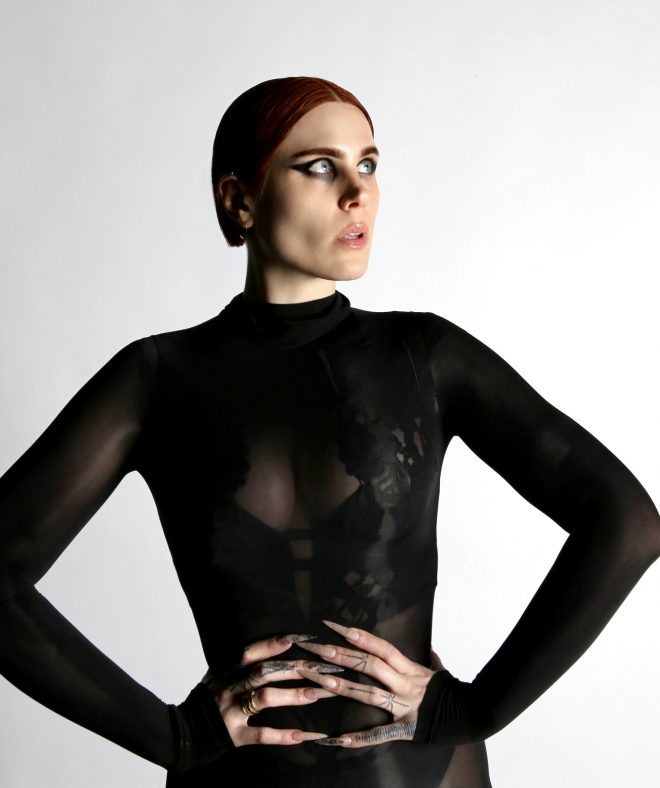
The emotional tension of Placid/Intrepid is not decorative. It reflects the contradictions that define the present moment, where people are more connected than ever and increasingly exhausted by that connection. The EP becomes a mirror for that state, tracing the strange pressure of living inside a world that demands constant awareness while making genuine contact harder to sustain. Its split structure is not simply sonic. It becomes a way of staging conflict.
That conflict is especially clear in the way NLI speaks about the title. For her, placidity and fearlessness are not opposites that cancel each other out. They are states that often exist together, particularly in a cultural moment shaped by anxiety, overstimulation, and the need to keep performing stability. The record turns that inner contradiction outward.
“Placid/Intrepid is about the collision of worlds, the possibility or even reality of two opposing sides coexisting in harmony. In the wider context of the world, I think this record may well stand as a subconscious reflection on human suffering and how we all seem to have this inner battle going on that is simultaneously striving for two opposing sides at once.
We see this wherever we go in the world. It seems our time has become increasingly more defined by contradictions. The internet and social media are the best examples of this. We’re constantly encouraged to post more, to be more aware of what’s going on in the world, and to be more ‘on.’ At the same time, people are currently experiencing more internet fatigue than ever before. Connection and human interaction are starting to feel like a chore for most, yet still we’re all putting out new content and engaging with it online like our lives depend on it.”
The first half of the release, Placid, leans into atmosphere rather than release. It operates through discomfort, decay, and slow psychological accumulation. There is tension in the sound design, but also in the refusal to resolve it neatly. The tracks seem to inhabit a world already under pressure, a place where noise becomes evidence of damage rather than ornament.
NLI’s interest in AI risk and technological collapse gives that atmosphere a wider frame. The point is not science fiction. It is the way human anxiety attaches itself to systems while avoiding the violence and domination already present in human behavior. In that sense, the EP’s unease feels less speculative than immediate.
“My music is the product of a very sick and dying world, which Placid/Intrepid really leans into in both a musical and conceptual sense. My most recent obsession outside of music has been reading up on AI x-risk, a proposed theory that the progress of AI may eventually lead to the destruction of humanity. I think it’s so interesting how mankind views technology as a bigger existential threat than other humans, especially in our day and age, when the world is becoming increasingly more unstable every day. I’d say the real danger lies inside our own human nature and innate desire to dominate, which differentiates us from any man-made technology. The EP explores this by tracing the human destruction that our presence has caused the world.”

That sense of collapse is not abstract for her. It comes from the atmosphere of the world around her, from political unrest, cultural fatigue, and a music industry increasingly shaped by instability and spectacle. The club, often imagined as a refuge, becomes part of that same pressure system. Even escape begins to feel contaminated by the world it tries to avoid.
“The EP is given substance by the world around us. Each track is crafted with intent and commentary on the important issues that are easily washed out by escapism, avoidance, and noise. Sometimes it feels like the music industry has become a real-life simulation of the real world, shaped by chaos, scandal, and uncertainty. I think the political unrest that we are currently experiencing on an international level has really trickled into all corners of the scene and is a major cause of anxiety for most of us. There’s a feeling of discomfort at the moment that is difficult to pinpoint, but it’s definitely there. I cannot recall how many smoking-area conversations I have had in the past few months about the world coming to an end.”
Stepping away from club functionality is part of the release’s argument. Placid does not exist to provide a tool for the dancefloor, and that refusal carries weight. In an environment where music is often assessed by its ability to perform quickly, visibly, and efficiently, NLI turns toward vulnerability and imperfection. She treats abstraction as a form of honesty.
That decision also reveals her wider critique of the current landscape. If every track is built for the same stage, the same clip, the same optimized reaction, the culture loses the margins that once made it alive. NLI’s position is clear: diversity in sound and perspective is not supplemental to club culture. It is its survival mechanism.
“In a world of curated perfection, I’m just trying to be vulnerable. I want people to feel something with my music. Being an artist has, for me, never been about making the ‘perfect’ track or creating something that will be trending, but about authenticity, human connection, vulnerability, and embracing the beauty of imperfection. I’ve always been a bit of an outsider in the industry in this way. I probably should be more focused on numbers, stats, and all the other figures that are important from a music business perspective, but sharpening my sonic signature and making music that aligns with the inner world of my audience, making them feel seen, valued, and included, is far higher on my priority list. At the end of the day, diversity, both in a musical and cultural sense, is the flesh and blood of our community, and if all of us only make music for huge arenas, then we will eventually purge the scene of all those who think in other terms than commercial success.”
The second half, Intrepid, returns toward techno without abandoning the questions raised earlier. It brings the release back into pressure, repetition, and warehouse physicality, but the energy is no longer innocent. After the unease of Placid, functionality itself feels changed. The club becomes another site of confrontation.
NLI’s frustration with social media-facing production culture sits sharply here. She is not rejecting visibility itself, but the way visibility can begin to dictate process. When music becomes content, the artist’s role shifts from making decisions to generating engagement. Intrepid pushes back by reclaiming authorship.
“That is something that I have always loved about noise music. It’s so raw and powerful. It pushes you to think and feel, which is unfortunately becoming the exception rather than the norm in music production. I wanted Placid to really challenge complacency in the music industry and reject mainstream conventions. I think a lot of the music that we hear nowadays caters to the demands of social media. A lot of the snippets we see in reels and carousels are essentially all the same, and the music is no longer the main element. We’re now focused more on the format, the crowd reaction, and the visuals, which are all fine in themselves, but I think it’s come to a point where we need to take a step back and reflect. Are we making music because we want to share it with the world, or are we making music to boost our own egos on social media?”
Her relationship with underground techno gives that critique a foundation. Berlin warehouses and underground spaces are not just aesthetic references in the EP. They represent a way of learning, one built through immersion, criticism, failure, and care. For NLI, the underground remains the place where techno’s meaning is most clearly tested.
That world, however, is under pressure. Rising costs, venue closures, and a lack of institutional protection have made survival increasingly difficult for the spaces that sustain the culture from below. The contradiction is painful: the global industry continues to profit from underground aesthetics while the actual infrastructure behind them becomes more fragile.
“I maintain a close relationship with that world. I cherish, adore, and respect that scene very much and think that underground culture is the beating heart of techno. I’ve learned some of my most important life lessons in the underground, both in a musical and personal sense. I think the underground is, in many ways, like a strict but nourishing mother for many artists. You will receive both some of the harshest criticism you will ever hear as a musician and the highest praise that will keep you going when you feel your world is about to collapse. It makes me sad to see how much the underground has suffered in the past few years. I keep hearing of clubs closing down due to increasing costs, which is suffocating the scene to a point where recovery seems impossible for small underground promoters and collectives. This makes me very sad, and it’s disappointing to hear that very little is being done by governments to help keep grassroots institutions running. I think that closing down these spaces is killing the scene, and I think we’ve now reached the point where the severity of the situation can no longer be underplayed.”

ADHESIVE emerges from that same refusal to compromise. The label is not built around numbers, prior status, or the performance of relevance. It is rooted in a belief that music should be judged by vision, technical strength, and the depth of the world an artist is trying to build. That sounds simple, but in the current industry climate, it becomes a position.
For NLI, the label is also a protective structure. It offers another route for artists who might otherwise feel forced to choose between visibility and integrity. The aim is not purity in a narrow sense, but independence with substance, a space where unusual work can be treated seriously without being flattened into trend logic.
“When I founded the label back in 2025, my goal wasn’t only to build a strong and reputable label from the ground up, but also to create a platform that respects the vision of the artist and puts them first. As an artist myself, I’m familiar with the difficulties that many new artists deal with when trying to break into the industry, and I know too well how it feels to find yourself in a situation where the choice stands between commercial success and artistic integrity. I personally think that nothing is worth compromising your identity, sound, and integrity as an artist. I also think that chasing trends and releasing music you don’t truly resonate with is the fastest way to having a short-lived career. ADHESIVE is deeply rooted in its philosophy of rejecting mainstream conventions within the music industry, both musically and socially. The label is built on releases that showcase talent, sonic versatility, and exceptional technical and creative ability when it comes to music production. We don’t really care how many followers you have or where you have released previously. The only thing that matters to us is the quality of your music and the depth of your artistic vision.”
The physical edition of Placid/Intrepid extends the same logic into visual form. Vinyl gives the EP weight outside the stream, a body in the real world that matches the severity of its themes. The artwork, with its use of blood, mortality, and sacrifice, pushes the project into a darker symbolic territory. It refuses the clean neutrality often attached to electronic music releases.
There is something deliberately confrontational in that choice. Blood functions as both life and death, presence and wound, identity and offering. It mirrors the EP’s own structure, where opposing forces are made to coexist without being resolved. The visual world does not explain the music. It intensifies it.
“To be completely honest, I’ve received a lot of messages since the release of Initiation asking if my music is available on vinyl, so it felt like the right time to do so. The cover art for the vinyl edition reimagines the sonic world of Placid/Intrepid through a much darker, more psychologically twisted lens and gives the EP a tangible presence in the real world. We played around a lot with visuals for the release, and I think we went through about twenty bottles of fake blood, which I then spent hours scrubbing off my face. Blood is a potent symbol representing mortality, identity, and sacrifice, which I thought would make a really interesting visual marker for the EP. In many cultures, it is also recognized as a dualistic symbol representing both life and death simultaneously, which aligns with the contextual duality of both the release and human nature more widely.”
What NLI argues for, ultimately, is a version of techno that remembers its discomfort. Not only its power, but its capacity to question, unsettle, and resist easy consumption. Her independence is not framed as separation from the scene, but as a way of remaining accountable to what she believes techno still has the capacity to be.
That position feels especially urgent in a moment when the genre is being pulled between underground renewal and commercial exhaustion. NLI sees the return to a more purist approach as a meaningful correction, but not as nostalgia. The point is not to go backward. It is to recover the seriousness of intent that gets lost when music is treated as content before it is treated as work.
“Artistic independence is everything to me. Staying in control of my creative vision and maintaining artistic integrity comes before all else. I think it’s now more important than ever to maintain your authenticity and not fall into the trap of following trends, especially for new artists who are trying to break into the scene. I’ve noticed an industry-wide return to a more purist approach to techno, which shows that we’re moving away from this extremely commercial and social media-focused kind of techno. I personally really welcome this, as I think a lot of artists are burnt out from trying to keep up with the social media circus and make music at the same time. I think that at this point, we should probably take a step back and think about how and why we use social media. Is it to share our music with the world or to boost our own egos?”
Placid/Intrepid lands because it refuses to make contradiction easier. It does not resolve calm and chaos, abstraction and function, beauty and decay. It holds them together long enough for the listener to feel the pressure between them. In doing so, NLI gives techno back one of its most vital qualities: the ability to disturb without losing connection.
