


VENDEX | NL 2026 #03
Vendex: building worlds beyond the dancefloor
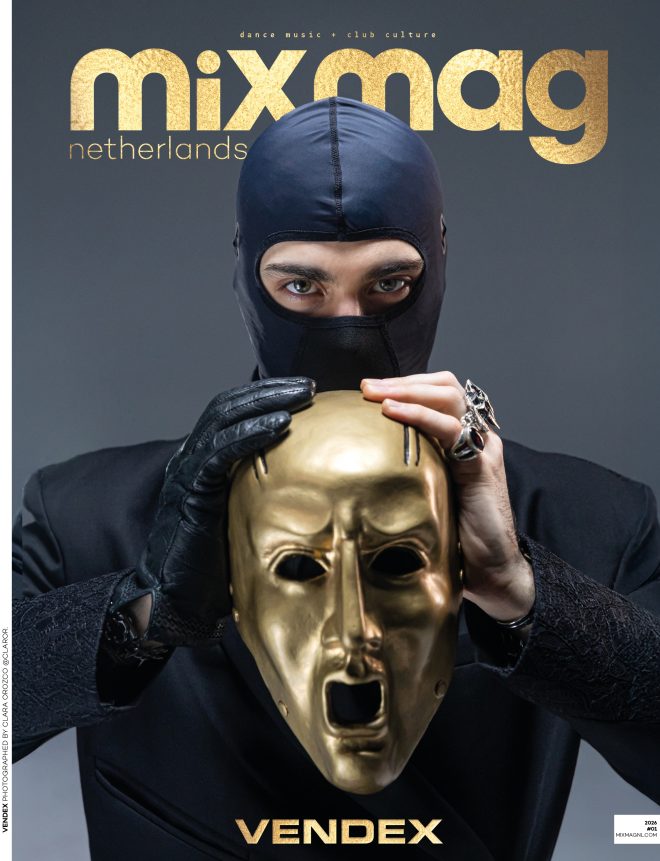
There is a particular kind of tension that defines Vendex. It does not begin with sound, nor with image, nor even with narrative in the traditional sense. It begins somewhere more elusive, in a space that feels closer to pressure than inspiration, something intangible that insists on taking form. From that initial disturbance, everything unfolds. The music becomes pulse, the narrative becomes structure, and the visual language becomes territory, shaping something that exists beyond the idea of a track. What emerges is not simply a piece of music, but an environment you step into, a state of mind that unfolds around you and pulls you inward.
“It always begins with a feeling. Something intangible, almost like a disturbance in the air that hasn’t yet taken shape as sound or image. I take that impulse and start building around my universe, giving it pulse through music, meaning through narrative, and identity through visuals. A Vendex piece is never just a track; it’s an environment, a state of mind. What begins as a feeling becomes something you can enter and experience.”
That instinctive process finds its deeper architecture in literature, particularly in the enduring imprint of Dante Alighieri and The Divine Comedy. For Vendex, the reference is not aesthetic decoration or intellectual homage. It is structural, almost philosophical. The descent into darkness, the confrontation with internal chaos, and the gradual, often painful movement toward clarity reflect something essential about what it means to be human. These are not distant metaphors. They are lived states, internal landscapes that shift constantly, and that translate naturally into sound when approached with intention.
“The Divine Comedy is not just a story about the afterlife; it is a map of the human condition. The descent into darkness and the confrontation with inner demons, followed by the slow ascent toward clarity, feels very real to me. What resonates is that the journey is internal; hell, purgatory, and paradise are states of mind. I do not try to retell Dante’s story, I translate its emotional structure into sound, turning it into something you feel physically as you move through it.”

Within that framework, Vendex’s work begins to reveal itself as more akin to world-building than to production. Each track, each transition, each moment inside a set functions as part of a larger system, an expanding mythology that exists under the umbrella of VALKHØR. The idea of chapters becomes relevant here, although not in a rigid or linear sense. Instead, what takes shape is a fluid map of interconnected zones, where emotions, spaces, and states of mind coexist and evolve in real time. The narrative is not imposed; it emerges through movement, through energy, through the constant negotiation between artist and audience.
“I think in chapters, but not in a fixed structure. It is more like a lore, an expanding map where everything connects within the VALKHØR universe. Each track represents a fragment of that world, sometimes an emotion, sometimes a place, sometimes a state of mind. When I build a set, I am navigating that map in real time, choosing paths depending on the energy of the moment. It becomes less about telling a story and more about revealing pieces of a larger mythology.”
VALKHØR itself stands as the clearest expression of that vision. What began as a personal extension of Vendex’s creative language quickly revealed itself as capable of expanding beyond the individual. As the project grew, so did its resonance, shifting from something personal into something collective, inhabited and interpreted by a wider community.
“VALKHØR was never meant to be just a label or an event. It was a way to give form to a world that existed beyond individual releases. I wanted to create a space where sound, visuals, and narrative could coexist under one identity. At some point, it stopped being something only mine. People began to connect with it, to project themselves into that universe. It became something collective, something you do not just observe, but step into.”
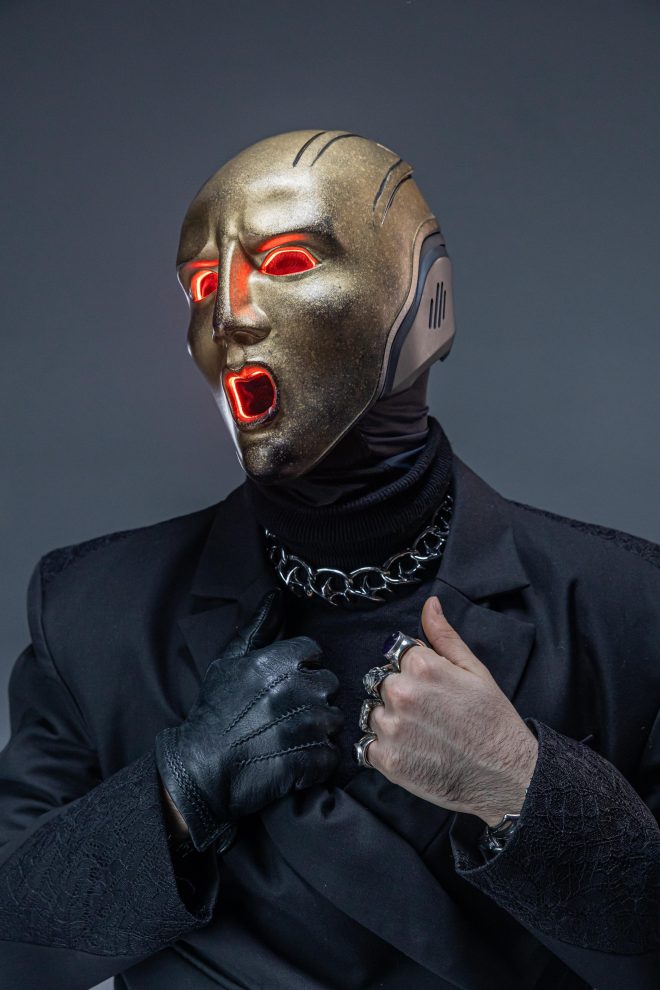
That expansion does not dilute its identity. If anything, it sharpens it. Vendex approaches curation not as a balancing act between personal expression and external voices, but as a continuation of a singular narrative vision. The criteria are not tied to genre, trends, or functional dancefloor expectations. They are rooted in presence, in an intangible quality that defines whether something belongs within the VALKHØR ecosystem. It is a form of recognition that operates beyond explanation, a coherence that is felt rather than described.
This same intentionality extends into how Vendex navigates the modern demands of visibility. The distinction between music and content becomes critical here. One operates on immediacy, the other requires time, depth, and maturation. Rather than collapsing the two into a single output stream, he maintains a deliberate separation, ensuring that what is shared remains aligned with the broader universe he is constructing. The goal is not consistency for its own sake, but coherence.
“Content and music are not the same for me. Content is immediate and reactive, while music needs time to grow and become real. I try to be intentional with what I share. It has to feel connected to the world I am building, not just something to fill a space or feed an algorithm. Everything I put out needs to carry a part of that universe.”
That discipline becomes essential in an industry defined by constant exposure. Sustaining creativity requires distance as much as presence, and Vendex approaches that balance with a clear sense of boundaries. Choosing when to engage and when to step back becomes part of the process itself, a necessary condition for maintaining both mental clarity and artistic integrity. The work is not only about output. It is about preservation.
At its most intense, that philosophy becomes visible in his live performances. There is always a moment, unpredictable yet unmistakable, where the separation between artist and audience dissolves. The structure of the set gives way to something more fluid, a unified experience where the music, the room, and the crowd's energy all sync up. It is within that convergence that the experience transcends performance and becomes something closer to ritual, a temporary suspension of individuality in favor of something collective.

“There is always a moment during a set where everything shifts. It is no longer me playing and the crowd listening; it becomes something shared. The sound, the space, and the people align, and the experience transforms into something else entirely. What matters to me is seeing people connect to my universe, feeling that they are part of it.”
Behind that immersion, however, lies a more complex internal landscape. Growth brings friction, and Vendex does not position himself outside of that reality. The most significant challenges are not external, but internal, rooted in self-expectation, overthinking, and the constant negotiation between ambition and balance. These tensions do not disappear. They are integrated, shaping both the pace and the direction of his evolution.
“My mind is my worst enemy. There is constant tension between overthinking, self-doubt, and the pressure I put on myself. I have had to learn how to slow down, become more intentional, and protect the core of what I do. Those challenges have shaped not only my career, but my identity as an artist.”
That same awareness defines his relationship with social media, a space that offers both expression and exhaustion in equal measure. The ability to express thoughts and feelings effectively remains valuable, yet the mechanics of constant output introduce a different kind of pressure. The balance lies in maintaining control, using the platform as a tool without allowing it to dictate the rhythm of creation or the direction of thought.
“Social media allows me to express what is inside my soul, to share ideas and emotions. At the same time, it feels like a system that constantly demands more the more you give. That dynamic can become overwhelming and affect my mental space. I try to stay aware of that, using it as a tool without letting it control how I create.”

Looking forward, Vendex’s trajectory expands far beyond the conventional boundaries of music. The next phase is not defined by releases alone, but by the continued construction of a multi-dimensional universe. VALKHØR evolves into a physical experience through events, while simultaneously extending into new mediums, from visual storytelling to objects, fashion, and potentially even interactive and cinematic formats. The ambition is not to scale for the sake of growth, but to deepen the immersion, to build something that exists across multiple layers of reality.
“Evolution for me means expanding Vendex beyond music. I want to develop VALKHØR events into fully immersive experiences, while continuing to grow the label and push its boundaries. At the same time, I am building the universe through comics, objects, and clothing, and by exploring spaces like video games and film. The goal is to create something that exists across dimensions, something you do not just listen to, but fully experience.”
In that sense, Vendex is not simply producing tracks or performing sets. He is constructing an ecosystem. A living, evolving world that operates on emotion, narrative, and presence, where the dancefloor becomes only one of many entry points.
MY THOUGHTS
Vendex comes across as someone who is not simply operating within the music industry but actively resisting its default logic. There is a clear refusal to reduce his work to output, metrics, or positioning. What stands out immediately is the way he frames creation as translation rather than production. That alone signals a different kind of mindset, one that is inward-facing, almost obsessive in its need to give shape to something intangible, as a person, that suggests sensitivity, but also a certain weight. People who create from that place tend to carry more than they show.
There is also a strong intellectual backbone to his thinking, but it does not feel forced or performative. The reference to Dante Alighieri is not aesthetic decoration. It reflects someone who has internalized narrative structures and uses them as a framework to understand both art and life. That kind of thinking usually comes from spending a lot of time alone with your own thoughts. It points to a personality that is introspective, analytical, and probably quite demanding of itself.
At the same time, there is a constant tension in him that feels very real. He openly acknowledges that his mind is his biggest challenge, which is something most artists experience but few articulate with such clarity. That honesty suggests self-awareness, but also an ongoing internal battle. He does not position himself as someone who has figured it out. Instead, he is someone in the middle of it, trying to build structure around something that could easily become overwhelming. That makes his work feel more grounded, even when the concepts are expansive.
What I find particularly interesting is his relationship with control. On one side, he is building an entire universe with VALKHØR, defining its identity with precision. On the other hand, he talks about letting things emerge, navigating energy in real time, and allowing the experience to unfold. That duality, control versus surrender, is usually where the most compelling artists operate. As a person, it suggests someone who needs structure to channel chaos, rather than eliminate it.
Ultimately, Vendex feels less like a “career artist” and more like a system builder. The ambition is not just to release music or play shows, but to construct something that can exist independently of him over time. That is a different level of thinking. It is long-term, almost architectural. At a human level, it reflects someone who is searching for meaning through creation, trying to leave behind something cohesive in a world that often feels fragmented.
