


BAD BOOMBOX | NL 2026 #02
The sound of freedom
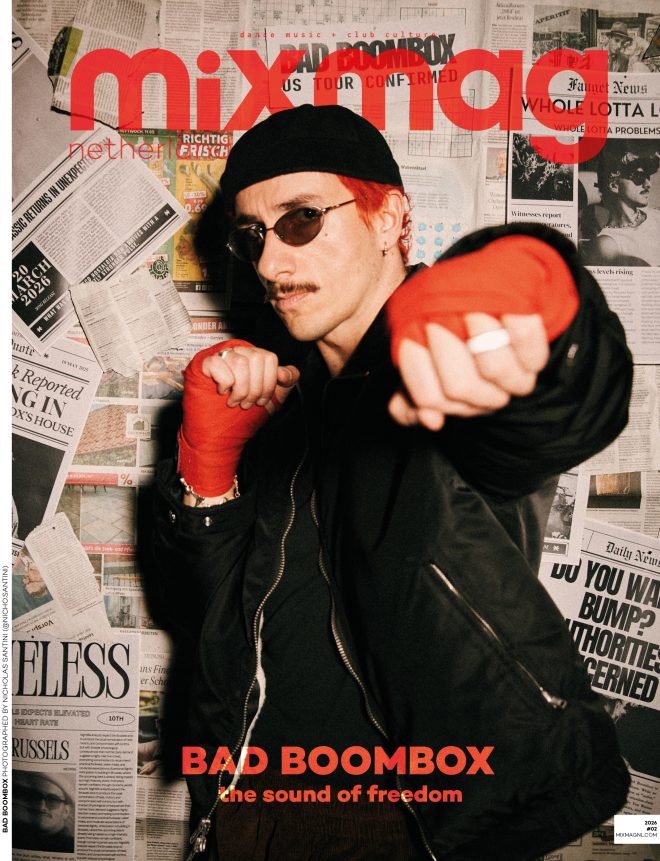
Electronic music rarely follows a straight line, and neither does the path of Bad Boombox. Born in Sofia, shaped by years in the United States, and now rooted in Berlin, his artistic identity moves between cultures with the same fluidity that defines his music. Each place left its imprint on how he hears rhythm, community, and the role of the dancefloor. What emerged from that journey is a sound that feels both restless and deeply connected to the roots of club culture.
The story behind Bad Boombox is also the story of persistence. More than a decade of experimentation across genres, aliases, and musical worlds slowly carved out the identity that now sits behind the name. Funk, disco, techno, trance, Balkan influences, and early-2000s rave energy all coexist inside his sets, not as calculated references but as instinctive impulses. That mixture reflects his personality as much as his musical taste, playful, curious, and unafraid to move in the opposite direction when trends start to feel predictable.
For many listeners, the first encounter with Bad Boombox happened during the pandemic, when his techno memes spread rapidly across social media. Humor became an unexpected entry point into a project that, beneath the satire, carries a very serious relationship with dance music culture. In this conversation he reflects on that unusual moment, the challenge of being taken seriously afterward, and the role humor can play in a scene that sometimes forgets its own sense of joy.
At the center of this feature is Influences Vol. 1, a project that reveals another side of his creative philosophy. Instead of sampling older records, Bad Boombox rebuilt the songs that shaped him using his own voice and instruments, treating influence as something to inhabit rather than simply reference. Across the following pages he speaks about musical identity, the physicality of the dancefloor, the cycles of electronic music trends, and the artists whose fearless creative freedom continues to inspire him. As the cover artist of this edition of Mixmag Netherlands, Bad Boombox offers a portrait of an artist who refuses to follow the algorithm, choosing instead to chase the instinct that first pulled him onto a dancefloor.
Bad Boombox’s musical identity was shaped across three very different worlds; childhood summers in Bulgaria, formative years in the United States, and creative freedom in Berlin, each leaving a distinct imprint on how he understands dance music.
“I was born in Sofia, Bulgaria and growing up I spent many summers in Bulgaria. Bulgaria has a profound electronic and house music history given its amazing coastal lifestyle, its unique and bustling capital city and its touch of post-Soviet effects on nightlife. When I was a kid my parents snuck me into some clubs on the Black Sea coast which ultimately shaped my love for dance music. I remember standing on that dancefloor as a kid, not understanding what the DJ was doing technically, but feeling completely fluent in what was happening emotionally. That was the first time I realized music could say something that nothing else could. I didn't have the words for it then, but looking back, that was the moment.
The US is where I actually learned to fight for it. I picked up cheap decks while at university in Washington DC, and started playing in basements and house parties before working my way up to clubs after some years. The European dance influence I was carrying was considered weird in that context, but I clumsily figured out early that weird, played with enough conviction, hits different. Growing up in the US surrounded by funk, disco, and Motown also meant I understood the blueprint and the bones that proper house music came from. I started treating both hemispheres as one toolkit. My only rule was there were no rules. Just whatever it felt like the room needed, but also what it didn't know it needed yet.
When I moved back to Europe to chase this creative freedom, all these scattered bits of dance culture I had absorbed started making sense together. I found people who had grown up feeling the same pull between different sounds and scenes, and that shared feeling became its own kind of community. I was just another person trying to find where they belonged, and Berlin turned out to be the place. Because it doesn't make you choose. For someone like me, that's everything.”
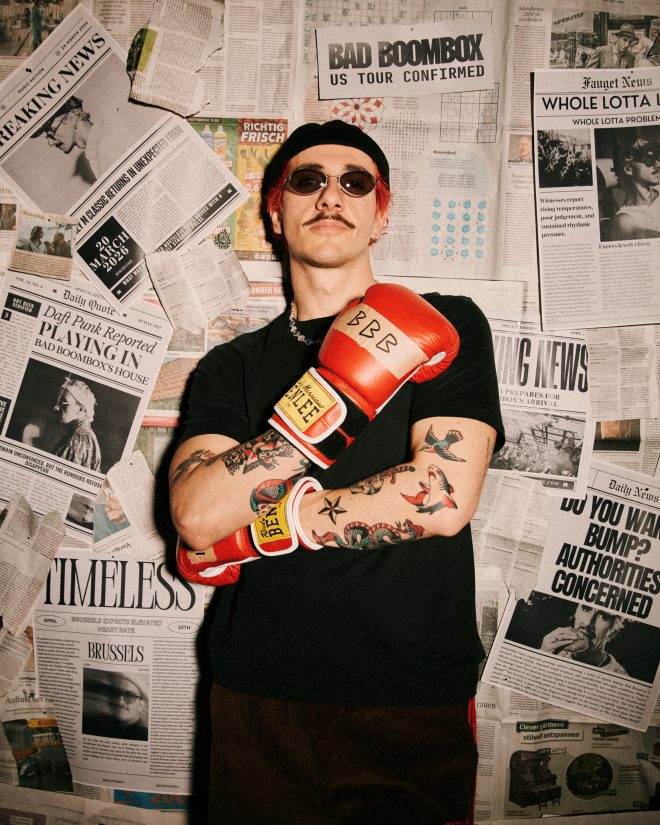
Looking back on more than a decade behind the decks, Bad Boombox describes a journey defined less by linear growth and more by constant reinvention, as each new project helped him move closer to the sound that finally felt like his own.
“My sound didn't just evolve, it took complete 180 degree turns many times. As a younger artist I kept getting pulled in different directions by whatever was trending, and for a while I let that confusion lead. Dance music moves fast, as I learned firsthand. Genres rise, peak, get mined, and collapse or fade within a few years, and the artists riding those waves either evolve out of them or disappear with them. I watched that cycle repeat itself enough times that it started to teach me something.
The honest advice I always give up-and-coming artists is that 99.9% of the time, their first project won't be the one that lands. And that's fine. The first few years you’re in a "learn like a sponge" phase where you're mostly recreating styles around you. The real work comes later, carving out your own corner through years of trial and error. Most artists you love today were discovered on their second or third or fourth alias. I was no different.
I've had artist projects as a pop dance producer, in a funk house trio, in tech house, trap, techno, even film composing. Each one added something to who I am today as an artist. Like an impulsive tattoo, it's about being fully committed to how you feel in that moment.
What eventually became Bad Boombox came from a defiant personality quirk I've always had. The second something starts feeling saturated and hollow, I'm already walking the other way. “Hard bounce” is a perfect recent example. The moment the hard techno bros adopted it as their new uniform last year, I had moved on. I'd rather build something new than follow a trend to its grave. I like what I like, not everything needs a wider audience.”
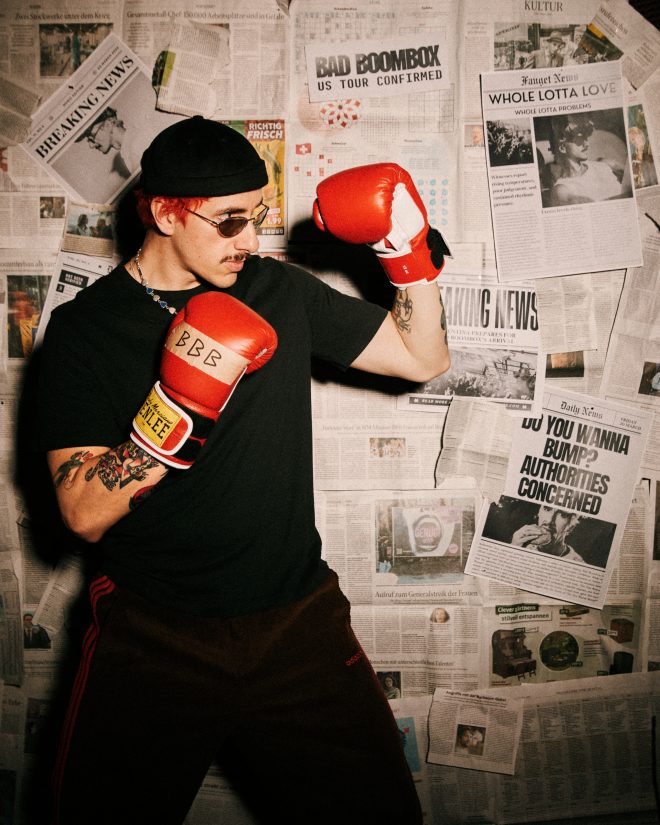
When the pandemic forced the global dance scene into silence, Bad Boombox unexpectedly found his audience through humor, using techno memes as a spontaneous form of expression that would later reshape how people discovered his music.
“The pandemic flipped everything on its head. Established artists panicked because the entire language of artistic communication changed overnight. For my music project it was quietly a gift, even if it didn't feel that way at first. Up to this point I'd been making music for years without quite cracking how to tell the story around it, and all of a sudden I had nothing but time and zero pressure.
With no gigs and no outlet, I started making videos that genuinely made me laugh, for myself. And techno at the time was so committed to being dark and serious and untouchable, so something about that felt ripe for messing with. I wasn't thinking about strategy, I was just bored and finding things funny, and apparently a lot of other people were too.
The honest truth is that it's easy to look back now and frame it as some clever move. But there was nothing clever about it. There was nothing to lose, so there was nothing to perform. That freedom is hard to replicate.
What came after was its own challenge. Convincing people that I wasn't just the meme guy, that there was real music and a real point of view behind the jokes, arguably took more work than starting from scratch would have. But I was never looking for a shortcut. Some lessons you can only learn the long way.
What stuck with me is that humor in dance music isn't a gimmick. Dance music is inherently about escape and release and joy. Artists who forget that and wrap themselves in self-importance and seriousness are missing the whole point. If you can't laugh at the thing you love, you probably don't love it that much, right?”
With Influences Vol. 1, Bad Boombox set out to reconnect club music with the deeper influences that shaped him, pulling inspiration from far beyond the boundaries of contemporary dancefloor trends.
“All music is connected. Not even just dance music, but everything creative. Every creative person carries a completely unique set of influences because no two people arrive at the same place the same way. Someone who grew up on jazz and folk, and also paints or cooks as a side hobby, is going to make something totally different from someone who only ever listened to what was already in their scene, just by pure probability. A lot of dance artists forget that. They go too deep into their subgenre and stop looking outside.
My job is to make people dance and to communicate something real in the process. So for this project I kept asking myself why I wasn't drawing from everything that actually shaped me, not just the music that was already club-ready. The answer was to go back further and drag those influences into the present. To make them hit in a warehouse at 5am.
Dance music has always been built on borrowing and repurposing because sampling is in its DNA. So what interested me was going one layer deeper, repurposing the repurposed. Artists from completely different genres have always looked at older music and filtered it through their own obsessions. Rock through blues, soul through gospel, funk through everything, etc. That process of transformation is what I f*cking love. The people who influence me most aren't necessarily the ones making the best music in a technical sense (whatever that even means), they're the ones who can zoom out, see the whole picture, and then get into a room alone and make exactly what the universe is telling them to make. I wanted a little whiff of that kind of freedom, and I tried to bottle it into this release.”
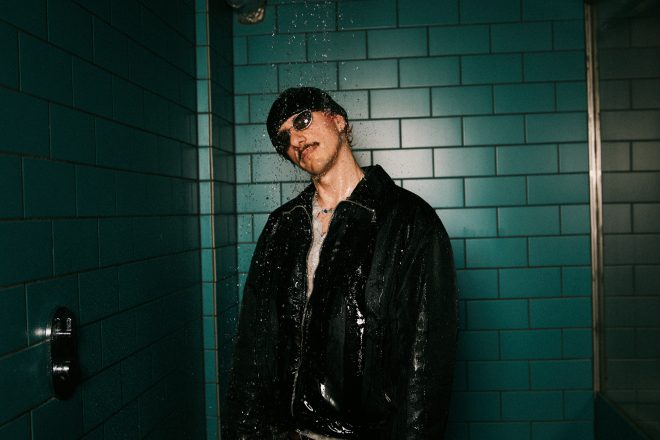
Rather than sampling the songs that inspired him, Bad Boombox chose to rebuild them entirely from scratch, a deliberate decision that forced him to engage with the emotional architecture of the originals.
“I'm obsessed with artists who create with no obstruction. That attitude is what I wanted to inject into this project. I've been sampling and making edits for over a decade and it's too easy at this point, to be frank. Anyone can sh*t out an edit; throw on a new kick and some hi-hats, maybe a deeper bassline and call it a day. So relying on someone else's original moment to tell your own story is a cheeky shortcut that always catches up with you (I’m speaking from experience). Getting up on stage with your big hands-in-the-air moment being someone else’s sound is not a great feeling. I think that you're not giving anything back, you're just borrowing indefinitely.
But these four original tracks I covered, I genuinely love them. And I wanted to feel even a small glimpse of what those original artists felt in the room when they made them. That's the thing about rebuilding a song from scratch, playing the guitar parts, singing the melodies, finding where the emotion actually lives in the song structure. You can't fake your way through that process the way you can with a sample.
Covers get dismissed in dance music but I think they're one of the most underrated tools a producer has. You're paying tribute to the original and leveling up your own writing at the same time. Nothing teaches you more about a song than taking it apart and putting it back together with your own hands. I need to feel something in the studio the same way I need to feel something on stage.
Remix culture is great. But remix culture needed to be remixed because we got lazy.”
For Bad Boombox, the true test of a track is not theory or structure but physical reaction, the instinctive moment when rhythm moves the body before the mind has time to analyze it.
“When I'm up there on stage, the rest of the world shuts off. For those few hours nothing exists outside of the music and the room. But what I'm playing has to make me actually dance. Everyone says that, but I mean it literally. If my knees aren't twitching and my hips aren't moving and my ass ain’t itchy, I can't do my job. That's been true since the beginning. I've always been hardwired for sounds and rhythms that do something physical to me before I even think about what they do to anyone else.
I'm a producer first, which means I spend a lot of time locked in a room alone. But even then the stage is always in my head like a projector beaming out onto the wall in front of me. When I start a beat I'm already imagining the moment someone hears it for the first time and tries to find the rhythm with their feet on the sticky dancefloor. It took thousands of hours of playing to real crowds to really cement that image, to understand in my bones what actually makes people move versus what just sounds good on paper.
So the testing process is pretty unglamorous. First I stand up in the studio and try to boogie to it. If it doesn't work on me in a small room at midday, it won't work on a dancefloor in the middle of the night. Then I test it in front of people that weekend before going back and tweaking. The dancefloor doesn't lie.
Most tracks don't pass the stand-up-and-dance test. Even fewer have that infectious pull where the momentum just carries people forward without them realizing it. But when the energy is right and everything clicks, you know immediately. That the track is worth putting out.”
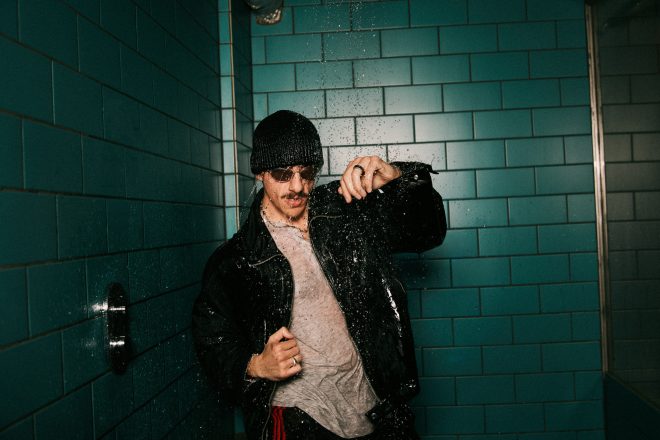
Having watched multiple genre cycles rise and fall since he began producing in 2012, Bad Boombox sees today’s club landscape approaching another moment where creativity risks becoming formulaic.
“Dance music runs in cycles. First a few maverick producers carve out something new, something that sounds weird at first but is still so memorable and infectious. Word spreads, talented people get influenced, the sound grows. All great things and everyone is drinking champagne. Then the commercial machine notices the financial potential, the corporate bros get briefed, and suddenly everyone is making the same thing with the same sounds (just louder). The final death stage is when the sample packs drop and the YouTube tutorials get uploaded with the subgenre’s name in the thumbnail and someone’s press photo slapped on top. Every time, without fail, roughly every three or four years. I've watched it happen repeatedly since I started.
This isn't a cynical take though. In the big picture it's actually freeing, because the real OGs stick with it and get their respect, and about fifteen years later some curious young producers dig back to the source and resurrect the whole thing. Then it starts again. We're still dancing, that's the point.
Right now in my specific corner of the scene, hardgroove and speed garage are at that tipping point. There are genuinely brilliant artists pushing the sound into places it hasn't been. But the copy-paste brigade has arrived, and we’re sitting with a demos folder every week with the same drum loop in thirty different tracks, I get so insanely bored of it all.
In the studio, my resistance to that wasn't graceful. I get in my own way constantly from incessant overthinking, chasing something new and different and then not finishing the track. It's a real struggle. But the times it clicks, I’m so energized, and that feeling makes every unfinished project worth it.
The advice I'd give any producer is to look past what's happening in your scene right now and dig into what influenced your favorite artists. Follow your taste all the way back to the source, then remake it. Try out some of your own sounds. That's where the real material is.”
The artists who continue to inspire Bad Boombox share a common thread; an instinctive trust in their creative impulses and a refusal to chase whatever sound currently dominates the scene.
“What all of these artists share is that they trust their intuition in the studio. They don't make music by reading the scene and filling a gap. They move like messengers, following whatever the creative instinct is telling them and trusting that if it feels true, it will land. They ignore what the audience may want, because that’s a fast track to sounding mid.
Most of these influences of mine also come from a punk rock background, not just in music genre but in attitude. That mindset is particularly powerful in dance music because it cuts through the overthinking. Dance production can become very analytical very quickly, and the punk instinct is what pulls you back into your body and out of your head.
Which leads to the thing I find most fascinating about all of them. So many of their best songs feel freestyled, like the idea fell from the sky and they just had the sense to get out of the way.
Try this: put on a beat, grab a microphone, close your eyes and just yap. Pure verbal diarrhea, no filter, doesn’t matter. Take yourself out of it and just think about being the universe’s messenger. A melodic riff, random lyrics, nonsense syllables, a hummed bassline, whatever. What comes out will be one thousand times more authentic and alive than you trying to “produce” your way through like you’re solving a math problem. And THAT is what the audience wants; not the technique nor the precision, but the feeling that someone got completely out of their own way and entered in a magical zone where the music was flowing through them.”
The artwork for Influences Vol. 1 captures Bad Boombox’s philosophy in a single image, a playful yet confrontational character that blends the energy of a boxer with the freedom of a disco dancer.
“The artwork came from the same place the music did. I started with a red canvas because red is assertive and a little confrontational, which felt right. Then I had this image in my head of an old traditional tattoo style boxer, except this boxer loves to disco. That contradiction is basically the whole project in one image.
I did an aggressive single-line drawing, loosely tracing the figure in my head without stopping to correct. The ink splashes and imperfections stayed in because the tracks in the EP are filled with these imperfections as well. What came out was freestyled and completely free from second-guessing, which mirrors exactly how the four tracks were made.
The boxer wants to fight the clichés, and the disco dancer wants to move through them. The red ties it together because red is sassy. Together they're something a bit ridiculous and a bit dangerous, which is about right for where I sit as Bad Boombox. And I of course have a great team around me helping this project come to life.”
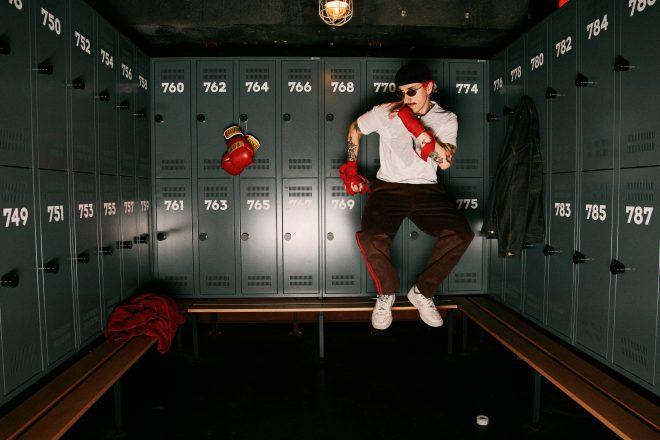
Living in Berlin has given Bad Boombox a front-row seat to the changing mood of club culture, where a new wave of artists and collectives are pushing the scene away from rigid seriousness and back toward joy.
“A few years ago my best friend and I were just sick of it. We'd spent so much time in Berlin, going to event after event, and the techno scene had become everything it was supposed to be against. Dark, pretentious, performative seriousness. The anti-establishment thing was becoming the establishment. Every party had this smug, monotonous energy that felt more like a dress code than a movement.
So we started Hot Meal Records as a direct challenge to that. We wanted color, fun, and actual excitement back in the club. The way it felt in the 90s and early 2000s before it got so serious about itself. Berlin carries a lot of weight in terms of where the global dance scene goes next, so it felt like the right place to experiment. Our collective, alongside a few others in the city who felt the same way, started offering something genuinely different. Groovy, positive, forward-looking, with artists who had something new to say. A real alternative to both the pretentious darkness and the commercial bastardized version of hard techno that was swallowing everything else.
That mentality is stronger now than when we started. More collectives and events with this vision have emerged across the city and if you haven’t visited Berlin in a few years, you’d find it almost unrecognizable today in my opinion, in the best possible way.
The same shift is happening in Amsterdam, Paris, Melbourne, Bogotá, and other cities that shape where dance culture goes globally. Young ravers are demanding something more soulful and the scene is responding. There are real challenges too, of course. Rising costs, shrinking margins, hostile authoritarian governments in many places. But when enough people want to dance, that energy finds a way, and always has. The delivery method changes and adapts but the need doesn't. Keeping that alive is our responsibility.
As for the dark and aggressive sounds, they can go do their thing. We'll be over here having a better time. Dance music was built on joy, some people just forgot.”
