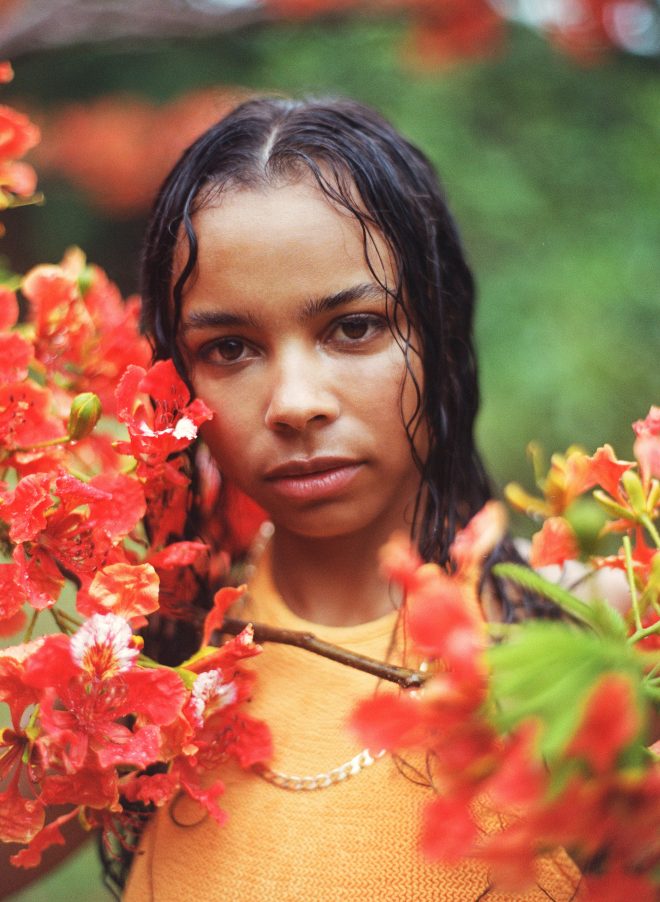


TSHA | NL 2026 #04
Finding form on the dancefloor

The room holds its breath for a moment before the drop, a brief suspension where everything feels suspended between control and release. TSHA stands at the centre of it. There is no excess in her movement, no need to signal what is already understood. The set unfolds with intention, each transition measured, each shift in rhythm calibrated against the response of the floor. It is in these spaces, somewhere between instinct and structure, that her music finds its clearest form.
What emerges now is the result of years spent moving between isolation and immersion, between building sound in private and testing it in front of bodies. The early expansiveness of her work is refined, pulled tighter around the mechanics of the club. Melody remains central, though it no longer drifts, it lands with purpose. There is a growing clarity in how her records function, how they hold both emotional weight and physical immediacy without forcing either into dominance. The balance feels less like a goal and more like a condition she has learned to trust.
This current phase carries that confidence forward without announcing itself as a reinvention. The foundations laid during her time with Ninja Tune remain visible, but they no longer define the limits of what she can do. New structures have begun to form around the music, from the physical world of Jackfruit to a sharper focus on how her tracks exist within a set. The direction is more direct now, more grounded in movement and response, yet it never fully abandons introspection. TSHA operates within that tension, allowing both sides to coexist without resolution, and letting the work continue to unfold in real time.
Within that movement, her own voice becomes more present, not only in the literal sense but in how she frames her trajectory. On our conversation, she reflected on the duality between her first two albums, the shift from internal exploration to physical immediacy, and the subtle ways club culture has reshaped her instincts. There is also a growing awareness of structure, of what it means to build something beyond individual releases, whether through a label, a live concept, or a long-term sonic identity. What she reveals is a series of positions, each one shaped by timing, environment, and the willingness to keep pushing beyond what already works

FOUNDATIONS IN MOTION
The shift happened gradually, almost beneath the surface, long before it became visible in the music itself. What now reads as a defined trajectory was, at the time, a series of small decisions, each one testing a different edge of possibility. The years with Ninja Tune sit at the core of that evolution. TSHA speaks about that chapter with a kind of grounded clarity, shaped by hindsight rather than nostalgia.
“That period with Ninja Tune honestly feels like my foundation years, like I did a lot of development and exploring as an artist. It was the first time I really had the space to figure out what I wanted to say and how I wanted to say it, without feeling like I had to rush into anything or define myself too quickly.” The emphasis is on process, on becoming rather than being.
Capricorn Sun carries that sense of early expansion, a record built from instinct as much as intention. There is a brightness that runs through it, even when it leans into more introspective territory, suggesting a need to reach outward rather than retreat.
“With Capricorn Sun, I was still very much proving to myself that I could make an album at all. It was quite external in a way, pulling from everything I loved growing up, UK dance culture, emotion and melody, but also trying to find where I fit within all of that. There was a lot of light in it, even when it touched on deeper feelings, and I think that came from me just being excited about the process of making something that felt like a full body of work.” The record allows them to coexist, loosely held but clearly felt.
By the time Sad Girl emerged, the environment around her had shifted, and with it, the internal logic of the music. Time spent in clubs began to shape the way intention translated into structure.
“By the time I got to Sad Girl, my music tastes and interests had evolved quite a lot. I had been DJing constantly, so production-wise I leaned even more into electronic and dance focused sounds. I wanted to continue exploring different directions and developing, and I didn’t want to be completely bound by the sonics of my first album. Sonically, it’s still connected, the same DNA is there, the same melodies and emotional intent, but it’s definitely more danceable and more immediate.” The shift feels deliberate without being forced, guided by context rather than strategy.
Looking back, the contrast between the two records appears clearly defined, though it was never constructed as a formal opposition. Each project reflects a specific moment, absorbing its emotional and physical surroundings without over-articulating them.
“At the time it wasn’t a super conscious decision, it was more a reflection of where I was at in my life. With Capricorn Sun, I was naturally leaning into that sense of light, warmth and melodic clarity because that’s what I needed then. It felt quite open and outward looking, like I was taking everything I loved and shaping it into something that felt hopeful and expansive.”
That outward gaze becomes a marker of its position in time, rather than a stylistic choice.
Sad Girl folds inward by comparison, though it never disconnects from the physicality of the dancefloor. The emotional register deepens, and the music carries a more direct sense of presence.
“By the time I made Sad Girl, I wanted to make it a lot more personal, so the music naturally became more introspective and vulnerable. I wasn’t trying to contrast it with the first record, it just ended up that way because I was in a completely different headspace. I was also DJing a lot more, playing in clubs every week, so that pulled me further into a more club focused, electronic direction without me really forcing it.” The two records begin to read as parallel states rather than separate identities, connected by timing as much as intention.

FROM ISOLATION TO IMPACT
That evolution extends into the mechanics of production, where scale gives way to precision without losing emotional depth. Earlier work was shaped in isolation, built patiently through layers and textures that emphasised atmosphere over immediacy.
“With Capricorn Sun, I was really leaning into that more orchestral, expansive world because I was producing a lot in isolation. I had the time and space to build things out, layer textures, and create something that felt quite cinematic. It was very much about atmosphere and emotion, and almost escaping into the music rather than thinking about how it would function anywhere else.” There is a sense of distance in that approach, a deliberate removal from the physical context of performance.
As touring intensified, that distance narrowed, replaced by a more immediate understanding of how music behaves in a room.
“As time went on, I was DJing a lot more, playing in clubs every week, and that inevitably started to shape how I approached production. With Sad Girl, I wanted things to feel more immediate, more physical, something that connected instantly on a dancefloor, so the production became more direct and more focused on that energy.” The introduction of her own voice sharpened that shift further, bringing a different kind of exposure into the process. “Bringing my own vocals into it was a big part of that as well. It made everything feel a lot more personal, and it forced a level of honesty because I couldn’t really hide behind anything anymore. Before, I was telling stories in a more abstract way, but using my own voice made it much more direct.” What changes is not the intent, but the level of proximity.
That same balance between intention and instinct continues to shape her own productions, where emotional depth and dancefloor functionality remain in constant dialogue. The process has become more attuned to movement, but it resists collapsing into a single approach.
“My process has definitely become more dance floor driven over time, just from being in clubs so much and understanding what actually works in a set. I’m thinking more about how a track lands, how it moves people, the energy, the pacing, the drums, all of that in a much more intentional way.” At the same time, there is space for divergence.
“Sometimes I want to make something that’s purely for the dance floor, and other times it’s more introspective and personal. I actually like keeping those two sides separate most of the time, and then when they come together naturally, that’s usually when something really interesting happens.”
BUILDING SYSTEMS, SHAPING FUTURES
That instinct for shaping extends beyond individual releases into the structure surrounding them. Jackfruit emerges as both an outlet and a framework, built from accumulated experience rather than sudden ambition. “Starting Jackfruit was a natural progression for me. I’d spent years releasing on other labels, and I got to a point where I wanted to build something that reflected my own taste and what I actually want to hear in clubs. It felt important to create a space where I could be more direct about that, without having to fit into anyone else’s vision.” The label operates with a clear sense of purpose, rooted in functionality rather than abstraction.
Its identity is deliberately stripped back, centred on the fundamentals of house music and the physical response it generates. “At its core, Jackfruit is about bringing back old-school flavours. It’s house music, it’s club focused, and it’s about records that actually work on a dance floor. There’s a certain energy and simplicity in older dance music that I think gets lost sometimes, and I really wanted to tap back into that in a way that still feels relevant now.” The process of selecting artists follows that same logic, guided more by instinct than analysis. “When it comes to signing artists like Ky William, BETH or Daisybelle, it’s really about whether the track hits in a club. I’m looking for strong grooves, solid drums, and something that DJs actually want to play. It’s less about overthinking and more about that immediate reaction.”
Balancing that curatorial role with her own artistic movement introduces a different kind of awareness. Each operates on a separate timeline, requiring different forms of attention. “As an artist, I follow instinct and what excites me in the moment, and that can change quite quickly. But with Jackfruit, I have to think more long-term, it’s about consistency, building trust, and creating something that people understand and want to be part of over time.” The separation is intentional, protecting both spaces from unnecessary overlap. “Even if something might appeal to me personally as an artist, it doesn’t always mean it’s right for the label. The label has its own identity and direction, and part of my role is protecting that rather than just following my own taste in the moment.”
When translated into physical space, that identity becomes tangible, shaped through atmosphere as much as sound. What began as a club night now operates as a contained environment with its own internal logic.
“From the beginning, it was always about creating a certain kind of environment. Not just another night out, but something that feels intentional the moment you walk in. The music, the energy, the crowd, it all needs to feel aligned in a way that you can sense immediately.” The emphasis on presence becomes central to that experience. “That’s why the phone-free element is such a big part of it. It changes the whole dynamic, people are more present, more open, and more connected to each other and the music. For me, that’s what house music was built on, and that’s what I want Jackfruit to represent in a real, physical way.”
A new phase begins to form through upcoming releases with Warner Music Group, extending her reach while sharpening her direction. The sonic language draws more explicitly from club culture, shaped by specific environments and their histories. “This project draws on a lot of the dance floor sounds of Ibiza, both past and present. It still carries some of the melodic elements people might recognise from Sad Girl, but sonically it’s definitely leaning more into the club space. It feels more direct, more confident, and more focused on how the records actually land within a set.” The movement feels focused rather than expansive, refining what is already present.
Collaboration remains part of that trajectory, approached with a clearer sense of alignment. Encounters with artists like Ellie Goulding and Gregory Porter have reinforced the importance of identity within shared work.
“Working with artists like Ellie Goulding and Gregory Porter showed me how different worlds can come together in a way that still feels cohesive. They’re very different artists, but both bring such a strong sense of identity, and that’s really what I’m drawn to when it comes to collaboration now.”
The emphasis shifts towards clarity rather than expansion. “It has to feel natural, like there’s a shared understanding or something that genuinely complements what I’m already doing. The best collaborations are the ones where both artists stay true to themselves, but meet somewhere in the middle, and that’s usually where something interesting happens.”
Across all of this, the idea of success remains deliberately understated, detached from external metrics or fixed outcomes. What matters is alignment, a sense of internal coherence that holds everything together.
“Success for me is just finding happiness, and feeling happy and confident with what I’ve put out into the world. As long as I feel like I’m growing and staying true to what I want to make, that’s enough.”
Across everything she builds, there is a clear sense that TSHA is no longer searching for direction, but refining how she moves within it. The conversation doesn’t circle around breakthroughs or defining moments. Instead, it returns to repetition, to time spent in clubs, to the accumulation of small decisions that begin to shape a more stable identity. Her work now sits closer to the floor, designed to function in real environments where attention shifts quickly and instinct matters more than concept. That shift doesn’t flatten the emotional side of her music, it gives it a more direct form.
As an artist, she allows herself to move quickly, following ideas as they come. Through Jackfruit, the pace changes, becoming more considered, more focused on continuity and trust. That distinction creates space, allowing each part of her practice to develop on its own terms. It also reflects a broader awareness of how scenes are built, not just through releases, but through environments, people, and shared expectations on the dancefloor.
In the end, what defines her position now is consistency of intent. She isn’t trying to resolve the balance between introspection and functionality, or between personal expression and club dynamics. Both remain active, sometimes separate, sometimes overlapping. That tension is part of the framework she’s building, one that allows her to keep adjusting without needing to reset. From where we stand, TSHA is not moving toward a fixed version of herself. She is building something that can hold change without losing its shape.