


Slim Soledad: Everything Was Already In Her Hands

Slim Soledad did not make her debut album because she finally discovered what she wanted to say. The material had been accumulating for years: bodies in motion, Brazilian rhythms, electronic devices, nightlife, transition, friendships, voices, memories. What changed was her belief that she could carry the weight of putting all of it together. Las Noches Calientes de La Soledad begins there, not with discovery, but with readiness. A record imagined long before she allowed herself to make it.
"I had to mature both artistically and personally. I'm the kind of person who likes to take things one step at a time and not take on more than I can carry. Before, I didn't feel ready to release an album because I believed it carried a weight I couldn't hold yet. Time, and the way my confidence changed, made me finally feel ready."
The distinction between having the material and being prepared to hold it is important. Slim's relationship with experimentation has never depended on the pursuit of novelty for its own sake. Across a year and a half of building the album, the process became one of recognition: understanding that the language she needed had already formed through everything she had lived, heard and made.
"It was all about building things little by little. I like to think of the album as a sticker book that you slowly fill in. It wasn't about searching for something completely new or trying to be innovative. I realised I already had everything in my hands. I just needed to understand my own repertoire better and find a way to organise it."
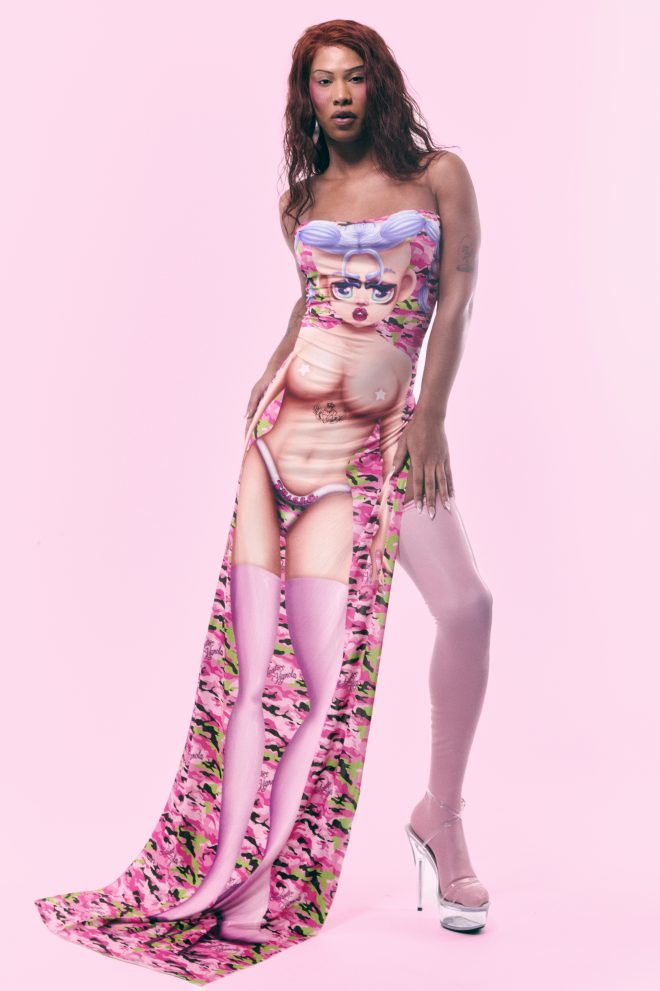
That repertoire is physical. High-velocity techno, Latin percussion, baile funk and experimental club music coexist throughout Slim's work, but she does not approach them as genres to be assembled into a calculated hybrid. Their relationship is more intimate than that. They have been present long enough to become embodied.
"I believe that when you're surrounded by these elements, they eventually become part of your body. At least that's how it happened for me. Every sound and element on the album holds a very intimate place for me, culturally but also personally, because I've built so many memories through them."
The body is one of the album's recurring sites of possibility. Slim understands the dancefloor as somewhere identity can be experienced rather than merely stated, where encounters with other people produce images of lives beyond the ones already available outside the club.
"The dancefloor is a space for bodily freedom, for seeing different images and possibilities, and for meeting people. I wanted these ideas at the centre of the album because the dancefloor was one of the places where I learned how to connect with others and imagine new horizons."
Her interest in what sound can do to a body predates the album. Projects including Vibrations, Translations explored relationships between sound, movement and ritual through performance, leaving behind ways of thinking that continue to enter the studio. Yet Slim resists reducing physicality to a predictable reaction, as though a sound must always instruct the body to move in one particular way.
"My previous performances have changed a lot about the way I think about making music. When I'm producing, I often think about bodily movement, but I also think about how sound can affect the body in a more sensory, non-choreographed way. It's not something completely linear for me."

That lack of linearity helps explain the album's construction. Randomness, repetition and syncopation have long been part of Slim's experiments with electronic devices. On Las Noches Calientes de La Soledad, those interests are not positioned as exercises separate from club music. They become part of the record's internal logic, accumulating gradually, like the sticker book she uses to describe its making.
The album also refuses the idea of the solitary debut. Its title may contain Soledad, but the record repeatedly opens outward, towards collaborators and the people whose presence has shaped Slim's understanding of herself.
"I will always preserve that sense of community because, as I always say, I am who I am because of the people who see me. Slim Soledad wouldn't be anything without community. My music and my art speak a lot about everything I've experienced through nightlife, especially collectively with other people. In that sense, the work is also made from the inside out."
Mapoas Only, featuring Clementaum, offered an early entrance into that collective world. Its formation was less the result of a formal plan than a series of associations that suddenly made sense together.
"It started from a random WhatsApp chat with my friend Alada. I already had the title in my head, and then I started connecting the dots. Clementaum and her 'Mayores Only' universe fit perfectly, as did the idea of womanhood behind the track. Everything strangely aligned. The whole album is also very much about collaboration and how much I believe in the sonic potential of the people I admire."

There is something revealing in Slim's description of things "strangely" aligning. The album was constructed patiently, but that patience did not require controlling every encounter. Its architecture leaves space for coincidence, for another artist to redirect an idea, for relationships to become part of the composition rather than simply credits attached to it.
The same openness appears in Slim's longstanding fascination with transformation. Earlier work such as La Leche Travesti approached transitional voices, while other projects have examined exchanges between material and immaterial states. On the debut, transformation becomes less a discrete subject than a condition of continuing to make work.
"Transformation and transition are continuous for me, both personally and artistically. I love movement, I love moving forward, I love giving myself challenges and being able to accomplish them. The album is also about how much I love continuing to transform, and how I've been sharing that process collectively. I think transformation is beautiful because it requires time and patience."
Time matters throughout Las Noches Calientes de La Soledad. There is the year and a half spent constructing it, but also the longer period during which Slim did not yet believe an album was something she should attempt. Patience, in this context, is not hesitation. It is part of transformation itself.
That changes the meaning of completion. Finishing a debut after waiting until she felt capable of carrying one has left Slim with a document that measures more than artistic development. Listening back has become unexpectedly emotional.
"I get very emotional when I listen to the album. Sometimes I find myself with tears in my eyes, but they're tears of happiness because I know I was able to achieve something important in my career. It speaks to me about courage, vulnerability, love, frustration and empowerment. Being at this point and feeling ready to share it with the world tells me that this is only the beginning of one of the chapters I'm writing."
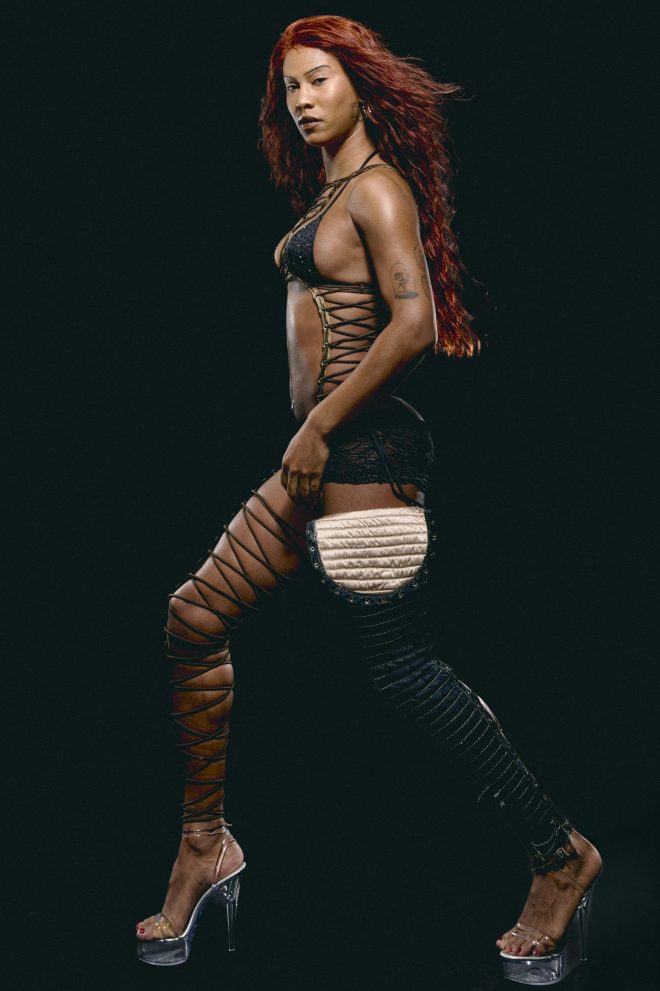
Those emotions coexist rather than resolving neatly. Courage sits beside vulnerability, love beside frustration. It is consistent with an artist who has spent years investigating transition without treating it as a simple movement from one fixed state into another.
The scale surrounding Slim is changing too. Recent appearances have included a B2B with Boys Noize and Junction 2 x Beatport in London. Larger international stages inevitably alter the physical circumstances around the work, but Slim does not describe community as something dependent on the dimensions of a room. It is closer to the source material itself.
"I am who I am because of the people who see me. Slim Soledad wouldn't be anything without community."
That statement places the audience in an unusual position. They are not simply recipients of a finished artistic identity. Being seen by others is part of how that identity has been produced. The dancefloor returns here to its wider function in Slim's work: a place where people encounter one another, construct possibilities together and leave changed by what they have witnessed.
It also complicates the solitude contained in her name. Las Noches Calientes de La Soledad is deeply personal, but very little about the story Slim tells of making it is isolated. Sounds enter through memory. Ideas develop through performance. Tracks emerge through conversation and collaboration. Identity is understood through other people looking back.
Five months after its release, Slim is still too close to the album to speak about it as something finished and safely behind her. What it has already changed is the scale of what she permits herself to imagine.
"The album has only been out for about five months, so everything still feels very fresh. But personally, it has already changed a lot about how I see myself, and I mean that in the best possible way."
There is a significant difference between the Slim who once considered an album a weight she could not yet hold and the one speaking now. The achievement itself matters, but perhaps more consequential is the evidence it leaves behind: she imagined something, gave it the necessary time, carried it through uncertainty and eventually let it exist outside her.
The response is not to declare the transformation complete. That would contradict almost everything she says about movement.
"I want Slim to have the opportunity and the space to dream bigger and bigger, with nothing blocking her right to dream, navigate and reach wherever she wants to go."
