


Meg10: What Survives When Representation Stops Selling?
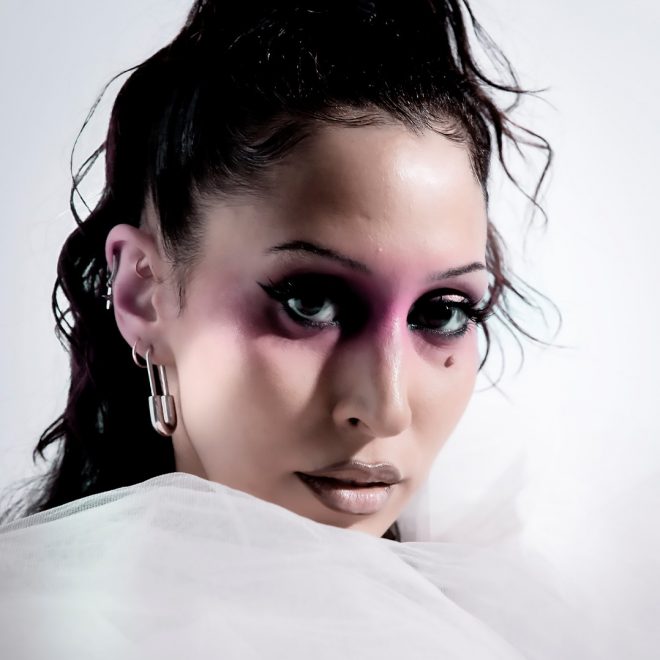
Hoe__mies was not built because representation had become desirable. It began because something was missing, and because being told to build the alternative yourself can sometimes become more useful than being invited into somebody else's room.
For MEG10, that moment arrived in Berlin before the language around diversity became commonplace across nightlife. Her political education and feminist campaigning already existed alongside a relationship with Hip Hop formed through the Rap and RnB of the 1990s and 2000s. By 2017, those worlds needed somewhere to meet.
"I wanted to create a space that sits between music and politics that I hadn't experienced before. The desire came from my background in political education and feminist campaigning and my love for Hip Hop growing up on Rap and RnB in the 90s and 2000s. I loved the music, but the typical Hip Hop parties felt like spaces that were catering to men, because they were usually organized by dudes, inviting male DJs to play music by male artists, and disregarding the bodily autonomy of female and queer guests, feeling generally rather unwelcoming to the latter.
"The straw that broke the camel's back was a RnB party I attended in 2016 that was built on the aesthetics of RnB divas, featuring music by female artists, basically an event for the girls, so I thought. I came to find out it was a group of gay men who thought it was unnecessary to involve women in any capacity, and when confronted with this feeling quite disempowering to me and other women who believed it was a female venture, they told me I should start my own thing if I didn't feel represented. At first I was angry, but today I'm glad this happened because it lit a fire under my ass to prove that we can create spaces for ourselves that prioritize the experience for female and queer people while centering female and LGBTQ artists."

Nearly ten years later, the conditions surrounding that decision have moved through several cultural cycles. Hoe__mies has watched representation go from something treated as provocative, to something institutions and brands actively sought, and into a period where that commitment appears increasingly conditional.
MEG10 once believed those changes would only move in one direction.
"Coming from academia, I always thought, the only way is forward: once we critically engage with gender, race or sexuality, once we understand discrimination, there'd be no return to the old status quo. Boy, was I wrong. In the beginning there was a lot of media attention on Hoe__mies that simply couldn't cope with a club night marrying two concepts believed to be polar opposites: Hip Hop and feminism. In the beginning the explicit sonic focus was on Hip Hop, it's evolved and opened up to include more genres since then. Our premise was treated as something sensational and avant garde.
"Over the years, we gained more mainstream appeal, lots of brands wanted to work with us as talents and curators alike to gain access to female and queer audiences and signal virtue. In today's political climate I know that we were merely part of a trend cycle rather than an indicator of genuine structural change.
"What that taught me is that visibility and structural power are two very different things. Structural change means changing who holds budgets, who makes decisions, who gets booked and commissioned, and embedding those changes deeply enough that they survive a shift in political or cultural currents. If representation disappears the moment it stops being fashionable, the structure was never transformed."
The current retreat cannot be separated from economics. Cultural funding has contracted, brands have withdrawn investment, production costs have increased and audiences themselves are absorbing a cost-of-living crisis. For an independent promoter, those forces meet in practical decisions about who can be booked and how much uncertainty a night can sustain.
"I think it's a combination of different factors. Conservative politics and resulting budget cuts for arts and culture on the state level, but also divestment from brands who were very involved at one point, have an undeniable impact on the diversity of lineups. Promoters and bookers are returning to familiar names because there's less room for taking financial and curatorial risks. It's an active choice at the expense of up and coming as well as marginalized artists.
"But as a promoter myself, I can't ignore the fact that we're in the middle of a recession. A night out can get costly considering rising ticket and drink prices, as well as transport costs. People have less disposable income so they're not going out as frequently any more, which changes who can still participate and who can't. Meanwhile rising production costs mean promoters need greater returns, which puts a strain on independent organizers and makes it harder to recoup the money we're investing into our creative vision. And unfortunately, when the margins become that tight, diversity and experimentation suffer."
Financial pressure has also altered the meaning of visibility. An artist's online reach can now operate as reassurance before their ability to hold a physical room has been tested.
"Within electronic music, I think that financial pressure has created an increasing reliance on artists who've already proven to sell tickets. Social media following, hype and name recognition are becoming a form of risk management. I've observed a tendency to favour artists backed by agencies, management, with existing platforms and financial privilege. And because the people who historically had the most opportunities to build their profile didn't quite champion diversity, falling back on the 'safe' option also reproduces existing inequalities.
"So it's unsurprising that this affects the grassroots ecosystem. If smaller promoters and club nights disappear because they simply cannot survive in this changing landscape, we're losing precisely these spaces where emerging artists can get their feet wet and hone their craft. And in the long run that can result in audiences shifting as well, because they don't feel connected to who's setting the tone for the night and there are less spaces available catering to different tastes and demographics."
For MEG10, the consequences extend beyond individual booking decisions. They change how DJs develop, how scenes encounter unfamiliar music, and eventually how nightlife imagines itself.
"In the long run, we're risking losing experimental curation, spaces to discover music and artists, local scenes that aren't polished but shape the underground, DJs developing over time by learning how to connect with a crowd gaining experience through playing at different times of the night. Someone getting booked because a curator heard them play an incredible 3 am set, rather than because they got 800k views on a reel.
"It feels like the craft of DJing takes a back seat to the ability of a DJ to produce engaging content. Social media used to be a tool to advertise events and document club culture. These days it's more like club culture is being produced in ways that make it consumable for social media. Community building isn't just something you do online. It also doesn't necessarily translate to the real world. The gag is, I've seen DJs with 100k followings play headline shows where merely 50 people showed up."
Hoe__mies has spent almost a decade developing a different understanding of community, one built through repeated physical encounters and relationships that have travelled beyond Berlin. Collaborations across four continents and 13 countries have connected the platform with scenes in cities including Tokyo, Melbourne, London, Paris, Lisbon, Barcelona, Amsterdam, Brussels and Lima. The point has never been to reproduce Berlin elsewhere.
"Much of our work relies on sisterhood based on shared values and beliefs that goes beyond the dance floor. Through touring I've made friends along the way. We help each other out with bookings in our regions and learn from how we each go about promoting our nights. Sound is contingent upon local context, and the best thing about connecting with likeminded collectives globally is learning about the genres emanating from their respective diasporas and queer scenes.
"For example in Melbourne we collaborated with Clubhaus, who attract a big South East Asian community and weave music genres such as Budots or Indo Bounce into sets that also feature Jersey Club or Brazilian Funk. Those exchanges have taught me that building a global community isn't about exporting the Hoe__mies formula or a Berlin understanding of queer nightlife. It's more about finding common ground while leaving room for the local cultural context."
The ten-year compilation now being assembled gives that history another form. Rather than treating the anniversary as an opportunity to gather whichever names currently carry the most visibility, MEG10 is approaching A&R through the relationships accumulated across the platform's life.
"Throughout the years, booking and curation has been my favorite thing about the parties. The biggest compliment for me is when people tell me that the lineup is sick. That tells me that my taste and who I think deserves a platform resonates with my community. Especially in my home town Berlin, where Techno and House is king, it's so important to shed a light on other genres under the global club music umbrella and showcase a diversity of sounds coming from the Global South diaspora and queer nightlife.
"Hoe__mies has made its mark in that sweet spot collaborating with collectives across four continents and 13 countries. In Berlin we're an important touch point for touring female and queer artists from the global underground and I'm very proud of that legacy. Therefore, the A&R process is less about putting together a compilation of who's hot atm, and more about leveraging these great relationships with DJs, recording artists and producers to celebrate this 10-year milestone. Artists who've been part of our journey, but also newer voices that represent where Hoe__mies is heading.
"Sonically, I want it to reflect our dancefloors: different interpretations of global club music connected by shared values. I want someone listening to the compilation to understand Hoe__mies without ever having stepped foot into one of our parties."
But preserving those dancefloors has become considerably more expensive. MEG10 was born and raised in Berlin, which means the transformation is measured not only through cultural memory but through invoices.
"When I started promoting in 2017, the financial barrier to entry was so much lower. I remember paying around €400 in venue rent and charging €8 for the first Hoe__mies parties. I was so reluctant to raise the cover to €10 because inclusive pricing was, and still is, important to me. Today, venue rent sits around €3,000 to €4,000 and our tickets are around €22 to €25. We offer half price community tickets always.
"Berlin was also buzzing and so much more affordable. Flights were dirt cheap, lots of tourists came in for a weekend and you could experiment as a promoter without going into debt. Pre-sale wasn't a thing for us before COVID disrupted nightlife, now we rely heavily on it to cover our costs up front. Since then, inflation has hit both sides: venue hire, production, travel, accommodation and artist fees have gone up, while the cost-of-living crisis means audiences have less disposable income. So we need to generate more revenue from people who can afford to spend less.
"And with so many venues closing at the same time, there are fewer spaces to work with in the first place. I genuinely don't know if I could start Hoe__mies from scratch under today's conditions. I'm sure a lot of people with great ideas feel the same way. And we'll never get to see them materialize because they lack capital."
Even an established night pulling between 800 and 1,200 people remains exposed to that arithmetic. Behind the visible event sits a much less visible structure of contracts, funding applications, awareness teams, door policies, promotion and personal financial risk.
"What people see is an established club night that regularly pulls 800 to 1200 people, has thought out lineups serving international talent, a recognizable aesthetic and a strong community focus. But in order to get there, me and my co-hustler Abi invest an enormous amount of time and money into every event. As an independent promoter, you're essentially betting that the community you've spent years building will show up and that the artists you carefully selected will resonate.
"You're coordinating awareness teams and door policies to make sure the values you advertise actually function in the physical space. And on top of producing the actual event, you're basically running a small media company year-round to make sure you're not swallowed up by the algorithm. Promo and content are probably the most exhausting topics for me.
"And in our case, there are no investors. No rich family absorbing the difference. No company bankrolling us, even though I spend countless nights working on pitches and applying for funding. Ultimately, every lineup, every production decision, every risk starts with me signing contracts worth thousands of euros months before a single ticket has been sold. And it's not even certain if I'm going to make any money with it, let alone break even. That financial exposure is probably where I feel the pressure most."
Ten years after Hoe__mies began, independence has become less an aesthetic position than a continuing negotiation over who gets access to the community and under what conditions.
"The motivation to start Hoe__mies didn't come from brands looking for queer audiences or because diversity was an industry talking point. We're here because there was something missing from Berlin nightlife that we wanted and needed for ourselves. The driving factor has always been this incredible feeling of getting together with our community, everyone looking after each other, getting the release they need, forming friendships around us, and being extremely grateful for the space.
"Hoe__mies existed before representation became commercially fashionable, and we still persist after it stopped being profitable. Sure, we may have benefited from its attention at times, but the industry retreating isn't going to render us redundant. I'm very protective of our space and selective about granting companies access to a community we spent 10 years building, and whose trust we've earned. I'm not opposed to working with brands per se. We've had partnerships that genuinely made sense for us. But I've also turned down money when the fit wasn't right, even when we could have used it. Independence can be costly, but it also means I get to do business on my own terms. The challenge now is figuring out how to make that sustainable without compromising why we started in the first place."
