


MAD DOG
The return to depth
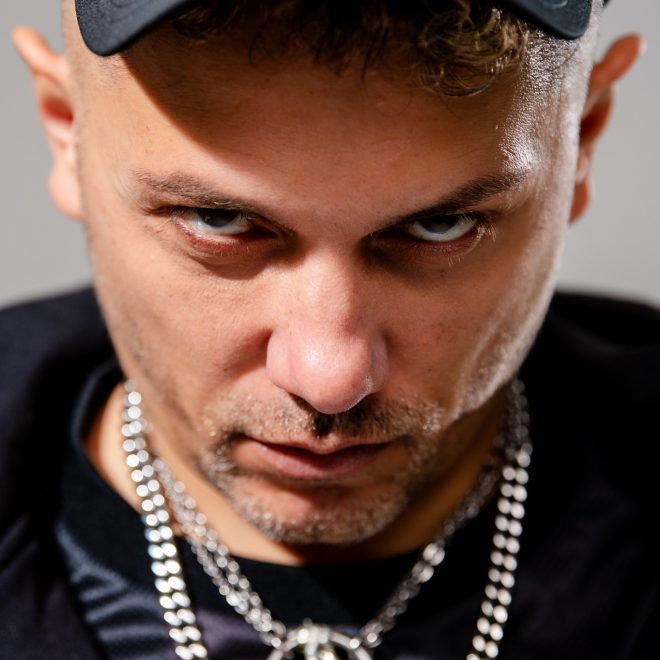
Some artists grow through reinvention, and others grow through insistence. Mad Dog has always been the latter. Behind the name, and long before the global stages, there was Filippo Calcagni, a teenager walking into Rome’s illegal raves between 1996 and 2000, discovering a world that felt more like destiny than diversion. His evolution since then has never been linear, never obedient to a genre’s comfort zone. It has been a long arc of pressure, release, collapse, reconstruction, and self-interrogation. Today, as the lines between Hardcore, Hardtechno, and Harddance mutate at dizzying speed, Mad Dog stands in the eye of the storm with a clarity sharpened by decades of endurance.
The story begins in those abandoned Roman spaces where early Hardcore, gabber, trance, and rough-edged techno bled through hand-built speakers. But the decisive encounters weren’t just musical. They were cultural and human. The nights were crowded with bodies, genders, styles, and identities that rarely met outside those walls. The sense of illegality, the danger, the lack of hierarchy, the handmade visual chaos, the feeling that anything unfiltered could happen at any moment; all of it fused into a single formative truth.
“Those raves were free artistic expressions where people of every background mixed without barriers.”
Rome taught him instinct. Thunderdome and the Dutch rave scene taught him theatricality. The combination would define the instinctive balance of rawness and precision that still runs through his career today.
ORIGINS AND THE FIRST COLLISIONS
The identity Filippo carried into adulthood wasn’t built in a studio. It was built on concrete floors, under ultraviolet lights, in rooms where music wasn’t just loud but life-altering. What struck him most was the emotional spectrum that Hardcore could contain: aggression, euphoria, melancholy, defiance. It was the opposite of perfection. It was imperfect in a way that felt truer than reality.
Those early encounters shaped a worldview rather than a genre preference. Hardcore wasn’t simply a fast BPM. It was a philosophy that elevated intensity into a code of honor. It was also a world that didn’t ask for permission. That spirit would become central to Mad Dog’s career, even in moments when he moved away from the genre’s traditional speed.
When he talks about his past, he does so with a kind of distance, as if the person who lived through those years exists but has already transformed into something else.
“The music you made yesterday belongs to a person who is no longer there,” he reflects.
It is not nostalgia. It is continuity. For Mad Dog, staying relevant has never come from holding on to history but from refusing to become it.
A CAREER BUILT ON THE PRESENT TENSE
Most artists define themselves through milestones: key releases, festival breakthroughs, signature tracks. But Mad Dog resists that narrative. He refuses to catalogue his legacy as a list of accomplishments because doing so would imply that its weight is behind him.
“I think my greatest achievement is still being on the scene today,” he says, and it lands not as modesty but as discipline.
He has watched generations rise and fade, artists with legendary tracks who couldn’t sustain the inner engine required to survive a scene as demanding as Hardcore. Remaining relevant in Hardcore is less about memory and more about stamina. The genre rewards the persistent and swallows the comfortable.
His resilience became even more visible when he challenged the direction Hardcore was taking before the pandemic. High BPMs, louder-than-life kicks, meme aesthetics, instant-impact drops: the genre was accelerating but losing narrative depth. For someone who grew up at the origins of Hardcore, the shift felt like a drift away from identity.
“I was tired of where the genre was going,” he admits. “I wanted to recreate a vibe that felt more serious, deeper, darker.”
COVID-19, with its forced silence, created the ideal moment to reconstruct from scratch. The result was a Downtempo Hardcore movement that realigned the genre's emotional core.
He didn’t plan for it to influence the scene, nor does he claim it did. But the change in BPM across events, artists, and promoters is visible today. Hardcore is no longer trapped in a linear escalation of speed. It breathes again. It listens again. There is room for tension, for nuance, for something other than shock.
His Downtempo work wasn’t a pivot. It was a return to source.
“A genre with more than 30 years of history deserves respect, not gimmicks,” he says, and it is perhaps the closest thing to a manifesto he has ever offered.
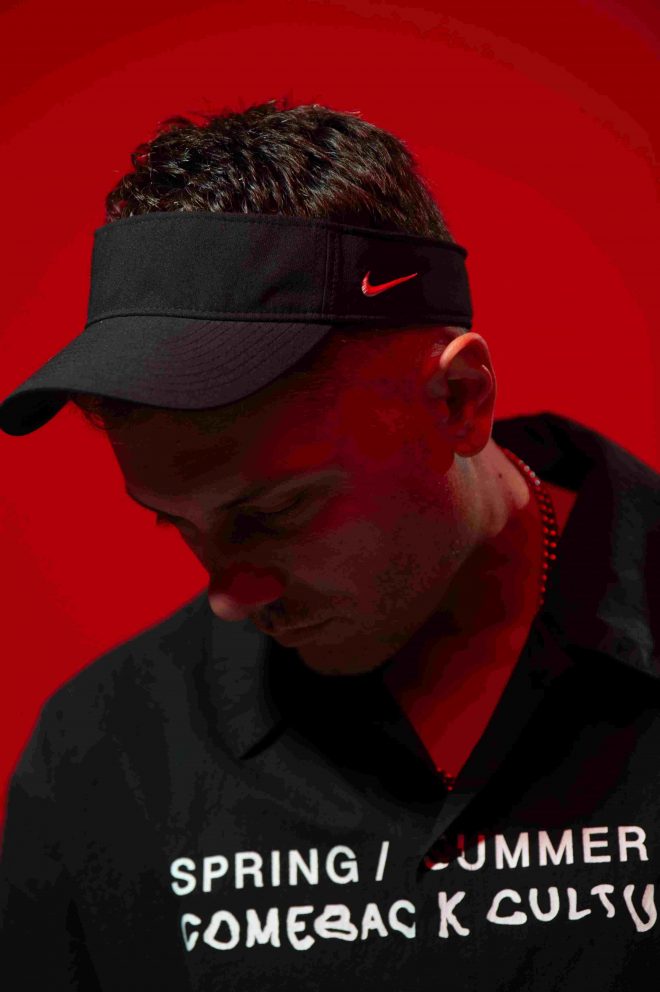
THE SHIFT INTO HARDTECHNO AND THE RENEWAL OF THE DJ
One of the most striking phases of Mad Dog’s evolution came when he entered the Hardtechno landscape, a move he never strategically planned. The shift was circumstantial, almost accidental, born from the intersection of Hardcore slowing down and Hardtechno speeding up. Suddenly, the two worlds overlapped, and Mad Dog’s sound landed right in the center of the collision.
The timing couldn’t have been better. Hardtechno was rediscovering the danger, rawness, and rave energy that Hardcore once carried in the 1990s. It was a world that valued physicality over perfection, risk over polish. The overlap allowed him to carry Hardcore’s density into a different kind of rhythmic architecture.
For years, he had functioned primarily as a producer who performed his own tracks. In Hardcore, that model worked flawlessly. In Hardtechno, it didn’t. The culture still valued the DJ as selector, as curator, as someone who interpreted the night rather than only contributing to it. That difference forced him to reopen a drawer he had closed long ago: the art of DJing as a craft rather than a vehicle.
He rekindled the skills he had honed in the late 90s: crate-digging, sequencing, creating contrasts, constructing tension through tracks other than his own. The shift expanded his vocabulary and reshaped his identity on stage.
“Track selection and preparation have become essential again. My sets are different from one another, and I have more fun when I play.”
This hybrid approach has allowed Mad Dog to bring Industrial Hardcore into Hardtechno spaces where the genre is rarely acknowledged. It has also allowed him to present energy differently. Not faster, not louder, but fuller.
“Whether it’s Hardcore or Hardtechno, the level of energy to transmit to the audience must be maximum,” he insists.
That shift also reshaped how he perceived success. The most decisive moment wasn’t on the biggest stages but during one of his first Downtempo sets in France, before the world noticed the change.
“People reacted brilliantly, and I felt the same energy as a fast Hardcore set,” he recalls.
It was the confirmation he needed, the revelation that he could reinvent without erasing himself.
DOGFIGHT, LEGACY, AND THE FUTURE HE IS BUILDING
Dogfight Records remains one of the most influential markers in modern Hardcore, a label that entered the elite in record time. But Mad Dog is blunt about its recent slowing down. His life has become an unbalanced equation: touring, producing, building a new studio, managing merchandise, keeping the label alive, and still trying to protect fragments of private life. Something had to suffer. And, for a while, it was Dogfight.
“I don’t like to delegate,” he admits.
It is not pride. It is a responsibility. Dogfight carries his name and his reputation, and he refuses to attach his identity to anything that doesn’t meet his internal standard. That is why the label has recently focused almost exclusively on his own tracks. He doesn’t have the time to manage other artists with the care they deserve.
Dogfight may one day return to broader releases, but only when the right team is in place. Until then, he prefers to protect his reputation with fewer but stronger statements. Ten years into its existence, the label is entering a reflective phase. Slowing down to recalibrate is not a sign of weakness. It is a sign of sustainability.
The forward path for Mad Dog is surprisingly simple. After decades of complexity, of reinvention, of adjusting to the tempo of an evolving scene, he has distilled his priorities into a single focus:
More music.
This year, he built his dream studio in Rome, designed by one of Italy’s top audio engineers. A professional space, not an indulgence. A tool that reduces friction and maximizes his limited time. It signals a new chapter where sound design, craftsmanship, and longevity converge.
If the last decade was about adaptation, the next one feels like consolidation. Mad Dog has nothing left to prove, and everything went to create. The genres around him may accelerate, mutate, fragment, and collide, but he has returned to the place where identity is most apparent: the work.
The same clarity he found in those illegal raves in Rome.
The same depth he reclaimed through Downtempo.
The same energy he rediscovered through DJing.
The same honesty that runs through every stage of his evolution.
