


Lisa Korver
Learning how to stay inside the moment while everything moves
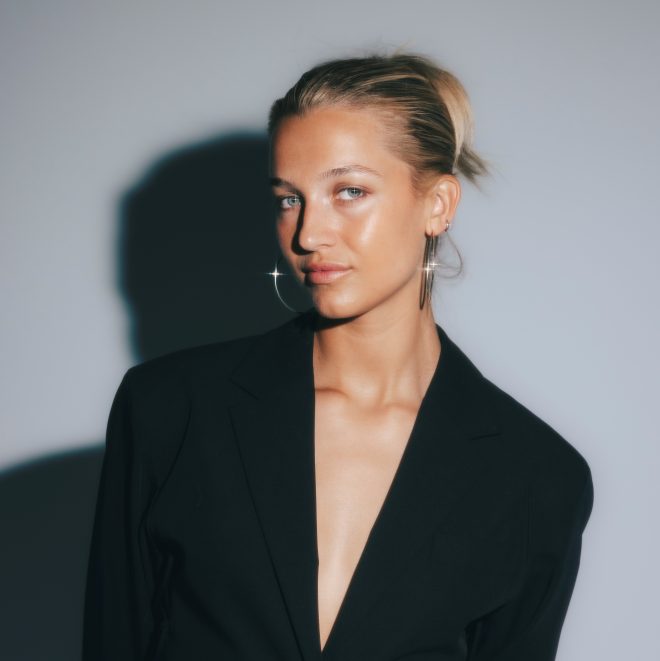
Momentum rarely announces itself. For Lisa Korver, the past year unfolded not as a clearly signposted rise, but as a sudden compression of time, opportunity and emotion. What now reads as a breakthrough year felt, while living it, strangely unreal.
“Looking back, it really was a turning point,” she says. “Not just because of the milestones, but because of how quickly everything happened. What made it so surreal is that it started with a completely empty summer calendar. No shows, nothing planned. And then, almost overnight, that space filled up with opportunities I never expected.”
At first, the acceleration barely registered. Only when she found herself physically present on those stages did the reality begin to settle in. Even then, enjoyment lagged behind achievement.
“During the year itself, I found it hard to fully enjoy those moments,” Korver admits. “So many new things were happening so fast that I was already looking ahead to the next one before I’d properly absorbed the last. It’s only now, at the end of the year, that I look back and think: wow, that was actually insane.”
That distance between experience and emotion became a lesson in itself. The realization that presence matters as much as progress has since reshaped how she approaches both life and music.
“I’ve learned how important it is for me to slow down and live more in the moment,” she reflects. “Not just the big shows, but the smaller things around them. The people I met that day. Who I was traveling with. The quiet, happy moments in between.”
One moment crystallized the shift from abstraction to reality. A phone call, fresh out of the shower, towel still wrapped around her head.
“My booker told me to sit down,” she remembers. “When he said I was confirmed for Lowlands, I just sat on the floor and cried. That was the moment it truly hit me. This is real now. My goals aren’t abstract anymore. They’re actually happening.”
Moving forward with intention, not urgency
If the past year was defined by acceleration, the next chapter is about recalibration. Looking toward 2026, Korver speaks less about expansion and more about balance.
“What excites me most is finding balance,” she says. “Artistically, emotionally and structurally. I feel like I’m entering a phase where things become more intentional. I trust my sound more now, and I’m less interested in chasing moments than in building something with depth and longevity.”
That shift is deeply emotional. After an intense breakthrough period, slowing down has become a form of self-preservation rather than hesitation.
“I want the next chapter to feel grounded,” she explains. “I want to actually experience what’s happening instead of constantly moving toward the next goal. That’s something I really learned this year.”
Structurally, this intention materializes through CURV, her newly launched label and cultural platform. Rather than functioning solely as an imprint, CURV is conceived as a space where sound, creativity and vision intersect.
“CURV is where everything can come together,” Korver says. “My sound, my creativity, and the broader ideas I want to explore. Through releases, events and curating emerging talent, I want to give more depth and context to the sounds I love, especially Latincore and hardgroove.”
The ambition is not louder, faster, or bigger. It is calmer, more focused, and rooted in long-term thinking.
Early releases as honest documentation
Revisiting her early releases now feels less like critique and more like recognition. Tracks such as Like That and Dale Duro remain important markers, even as her sound continues to evolve.
“Those tracks feel like snapshots of a very specific moment in my journey,” she says. “They represent the beginning of my production process, a phase of experimenting and discovering what felt right.”
Like That connected with a broad audience, something she appreciates without reservation.
“I genuinely value how many people connected with that track,” Korver notes. “At the same time, it sits a bit further away from where my sound is today. I don’t play it very often anymore, not because I reject it, but because my musical focus has shifted.”
By contrast, Dale Duro and later releases remain deeply embedded in her sets.
“Those tracks still live very naturally in how I play,” she explains. “They form the foundation of how I move through energy on the dancefloor. I see them as a starting point,” she says. “They show curiosity, growth, and honesty. From that foundation, I’m evolving toward a sound that feels more defined and more true to who I am.”
Music written for bodies first
Before genre or technique, Korver’s primary concern is physical response.
“What I want, before anything else, is for people to move,” she says. “When someone hears one of my tracks in a club, I want that instinctive reaction where you just want to go to the dancefloor.”
Her production process begins with the club in mind.
“I think in terms of bodies, space, heat and energy,” she explains. “Not headphones or streams. The drums, synths and groove are meant to take over your body first, before your brain catches up.”
Vocals appear as playful, connective elements, but never dominate.
“I love using vocals because they’re recognizable and they bring connection,” Korver says. “But I always want the rhythm to stay in control.”
The feeling she is chasing is both collective and personal.
“I want people to feel free in their own bodies. Sweaty, confident, present,” she says. “At the same time, the music is very focused on you as an individual. When that comes together in a room, the energy becomes unexplainable.”
Nostalgia as emotional language
While listeners often assume her sound is rooted in South American cultural heritage, Korver experiences that influence on an emotional rather than literal level.
“My roots are actually much closer to home,” she explains. “My first encounters with electronic music happened in small clubs near where I grew up. That’s where global club sounds and early Dutch club energy came together for me.”
That era shaped how electronic music felt to her: physical, playful and communal. Later, techno and trance expanded her emotional palette. Hearing To-K by DJ Babatr became a pivotal moment.
“It felt like everything I loved growing up and everything I love now existed in the same space,” she says.
To keep her music forward-facing, Korver grounds nostalgia in contemporary frameworks.
“Nostalgia gives the music warmth and emotion,” she explains. “But it always has to live in the present. I focus on modern structures and sound design so it doesn’t become repetition.”
Her goal is duality.
“I want my tracks to feel familiar and exciting at the same time,” she says. “Something you could listen to on your bike, but also completely lose yourself to in a club at three in the morning.”
Inspiration arrives through deliberate digging. Long sessions on SoundCloud and Bandcamp expose her to sounds far outside her immediate scene.
“Even if I’d never play a track, I might take inspiration from a drum pattern, an arrangement or a texture,” she explains.
Fashion is inseparable from her musical identity.
“With my background in fashion, I see sound, image and identity as one language,” Korver says. “Music and fashion really reinforce each other.”
Artists such as Peggy Gou and VTSS resonate precisely because of how seamlessly they merge sound, style and presence.
“That intersection is where my creativity feels most alive,” she says.
CURV as a living ecosystem
CURV was never conceived as a strategic career move. It emerged slowly, out of necessity and emotion, as a place where Korver could gather the different strands of her identity without having to separate sound, vision and intention.
The name itself carries personal gravity. It comes from her father’s nickname, a subtle but deeply felt tribute to someone who supported her from the very beginning.
“Naming the imprint after that felt really meaningful to me,” she says. “It’s not something loud or obvious, but it’s always there.”
Philosophically, CURV reflects how she moves through both music and life. The idea of motion without rigidity, of growth without hard edges.
“For me, CURV stands for movement, flexibility and fluidity,” Korver explains. “It’s about evolving without becoming stuck in one version of yourself.”
Running her own imprint has shifted her relationship with time. Without external expectations dictating pace or direction, she is able to think beyond single releases and short-term impact.
“It gives me space to think long-term,” she says. “Not just about tracks, but about ideas, atmosphere, people. About how things develop over time rather than how quickly they land.”
What excites her most is the opportunity to nurture emerging producers who resonate with this sonic and emotional world. CURV is not positioned as a gatekeeper, but as a place of trust and shared curiosity.
“I really care about giving a platform to smaller, emerging artists,” Korver says. “People who might not fit neatly into existing boxes, but whose sound carries honesty and energy. I trust the process,” she adds. “CURV isn’t about quick wins or hype cycles. It’s about building character over time. Community is the most important part for me,” she says. “I’ve really tried to create a space that feels open, warm and safe, where people can just exist as themselves.”
Over time, that intention began to manifest organically. The crowd shifted. The rooms felt different.
“A lot of women and queer people started coming to dance and connect,” she notes. “That wasn’t something I planned, but it felt very natural.”
One moment, in particular, confirmed that what she was building resonated beyond music.
When her all-nighter sold out within hours, with the vast majority of tickets bought by women, the impact landed quietly but deeply. It was not about numbers, but about recognition. It was proof that CURV had become more than a label. It was a shared space. A living ecosystem shaped as much by the people inside it as by the sound that moves through it.
“My all-nighter sold out within a few hours, and most of the tickets were bought by women. That felt like a quiet but powerful validation of what I’m trying to build. When people feel free in their own body while sharing a room,” she says, “the energy becomes incredibly powerful.”
Chasing connection over milestones
Beyond festivals and achievements, Korver’s deeper motivation remains connection.
“The moments that stay with me are the people I meet along the way. I started because I loved it and wanted to see where it would take me,” she says. “Milestones can be exciting, but they’re never the memories that last.”
Looking ahead, her hopes are simple.
“In five years, I hope CURV has grown into something much bigger,” she says. “And personally, I hope I’m still happy, curious and genuinely enjoying what I do. Playing huge stages would be amazing.”
Korver concludes.
“Meeting thousands of beautiful people along the way matters even more… You won’t remember the stage you played, you’ll remember the people you shared it with.” That is the future she is building toward.
Lisa Korver’s next release will be out on the 30th of January on CURV Records.
