


DAVYBOI
Born on the Dancefloor, Built on Emotion

The conversation with DAVYBOI did not feel like an interview in the traditional sense. There was no rush to define genres, no checklist of achievements to get through, no neat narrative waiting to be polished. Instead, what unfolded was a reflection on instinct, rebellion, discipline, and the strange emotional intelligence required to move a room at full speed without losing its soul. This was less about explaining who DAVYBOI is, and more about understanding why he moves the way he does, musically and personally.
At the center of the discussion was a recurring tension that defines the project of DAVYBOI: emotion versus adrenaline, chaos versus structure, irony versus sincerity. He speaks openly about coming from the dancefloor before the booth, about frustration turning into motivation, and about building a career not through permission but through insistence. His relationship with trance, high-energy dance music, and performance culture is rooted in feeling first, numbers second, and that philosophy runs through everything he touches, from how he mixes to how he presents himself online.
What makes this exchange resonate is its honesty. DAVYBOI reflects on Gen Z visibility, mental health, discipline, community, and the pressure to stay relevant in a saturated scene without losing joy or perspective. He talks about social media without cynicism, about the dancefloor as a space of collective release, and about the slow, deliberate work of building an identity that feels unmistakably his own. This interview is not about hype or momentum. It is about energy with intention, movement with meaning, and the belief that even in an accelerated culture, real connection still happens when a room breathes together.
When DAVYBOI says his sound was born on the dancefloor, he means it literally. Not as a metaphor, not as a romantic shortcut, but as a physical and emotional moment of rupture. A night when something in the room felt wrong. Too rigid. Too predictable. Too far removed from the feeling that first pulled him into club culture.
“There was this one night where I realized I couldn’t stand the hard techno direction that dominated everything around me anymore. I remember thinking: fuck it. If nobody brings trance to Munich, I will.”
What followed was not a strategic pivot, but a form of resistance. A stubborn insistence on emotion in a space that had begun to prioritize pressure over release. At the time, trance barely existed in his region. That absence became fuel. He started playing it for friends, then for his hometown, trusting that if people truly felt it, they would understand.
“It felt less like a career decision and more like a personal rebellion, a belief that people would fall in love with this sound the moment they truly felt it.”
That belief carried further than expected. What began as a local impulse slowly unfolded into a life on the road, travelling with the music he loved rather than chasing what was already dominant. Yet despite the scale changing, the internal reference point never did.
“That raver version of me is still very present. Every time I play, I picture him somewhere in the crowd. My internal question is always: would he lose his mind to this right now? That imagined version of myself keeps me honest. Keeps me performing for emotion, not ego.”
BETWEEN EMOTION AND ADRENALINE
On paper, DAVYBOI’s sound moves fast. Trance, eurodance, hardhouse. Euphoric, high-energy, relentless. But the speed is not the starting point, and numbers are never the framework.
“BPMs are almost irrelevant to me. I’ve heard 148 BPM tracks hit harder than 165 BPM ones.”
What guides him instead is feeling. A constant reading of the room’s emotional temperature. Faces, movement, posture, attention. His role is not to impose energy, but to translate it, to meet the crowd where they are without losing his own identity in the process.
“I never start from numbers. I start from a feeling.”
That approach demands presence. No pre-built narratives are waiting to be deployed, no autopilot moments behind the decks. Every set is a live conversation.
“I’m searching for a real connection. Watching faces, sensing when the energy drops, finding that one track that unlocks a smile or a memory. If I walk into a hard slot and the crowd is already exhausted, it becomes almost a challenge. Can I still reach them? Can I recharge them?”
It is in that fragile space, between emotional fatigue and physical adrenaline, where DAVYBOI feels most alive as a performer.
“That tension between emotion and adrenaline is where my best sets happen.”
GENERATION Z AND THE NEW INDUSTRY
DAVYBOI belongs to a generation that never learned to separate the artist from the human. Raised online, but not in a polished or distant way, he grew up sharing space, struggles, and process in real time. His community does not only see the highlights.
“Being a Gen Z artist means showing the whole human, not just the DJ. My community sees me celebrate a release, but they also see me struggle with mental health or spend my birthday at an airport. I don’t want to be a distant figure. I’m still one of them, someone who danced on the same floors they’re on now. When I promote a track, you’ll see me dancing like an idiot to it, because that’s literally how I want people to feel when they hear it.”
For his generation, success is not a single metric.
“It’s not only charts or labels. It’s about connection. Building a community and staying honest and accessible. Social media is a huge reason why I’m here today. I don’t see it as a necessary evil. I see it as a creative tool. We grew up with swipe culture. People don’t want long breaks or repeated drops. They want movement, surprise, momentum.”
Still, DAVYBOI is clear about where meaning is created.
“The scroll is the invitation, not the destination. Social media gets people in the door, but the memory is made on the dancefloor. At that point, it’s no longer about algorithms. It’s about emotion, connection, and that moment where the whole room breathes in sync. The algorithm doesn’t decide that. I do.”
There is a lightness to how DAVYBOI moves through the world, a kind of humor that disarms before it explains. In his case, irony is not a mask. It is a pressure valve. A way of staying human in a culture that constantly asks artists to harden their image, to polish themselves into something distant and untouchable.
For him, authenticity is not something you build. It is something that remains once the performance anxiety disappears.
“Authenticity isn’t something you try to achieve. It’s what’s left when you stop trying. The person you meet on the street is the same person you see online. Same humor, same chaos, same honesty.”
That continuity is felt immediately. People recognize it because it does not ask to be admired, only understood. Still, there is one precise moment where playfulness gives way to intention.
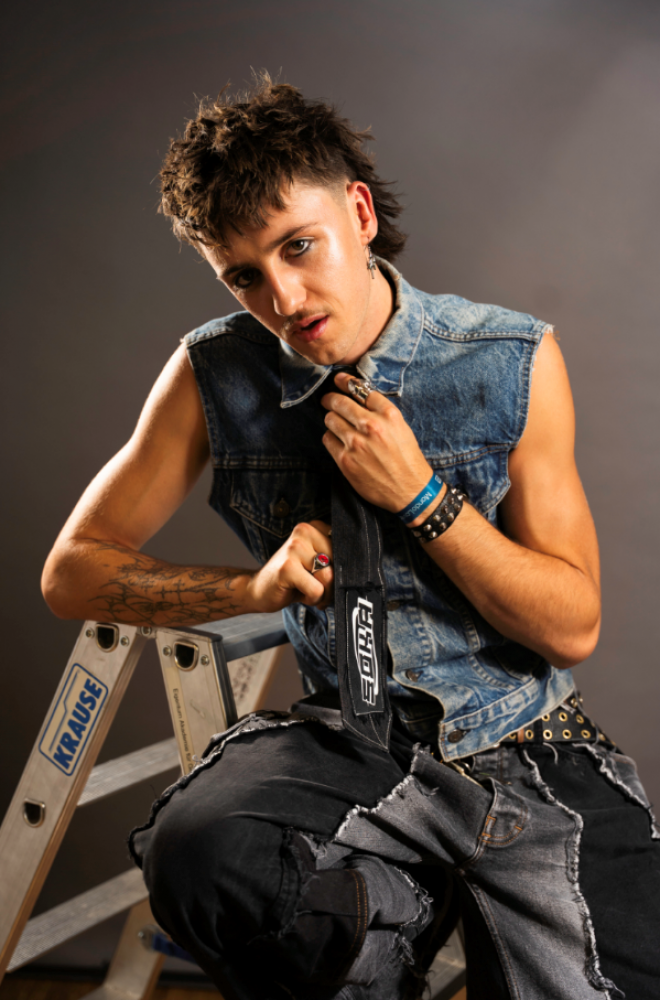
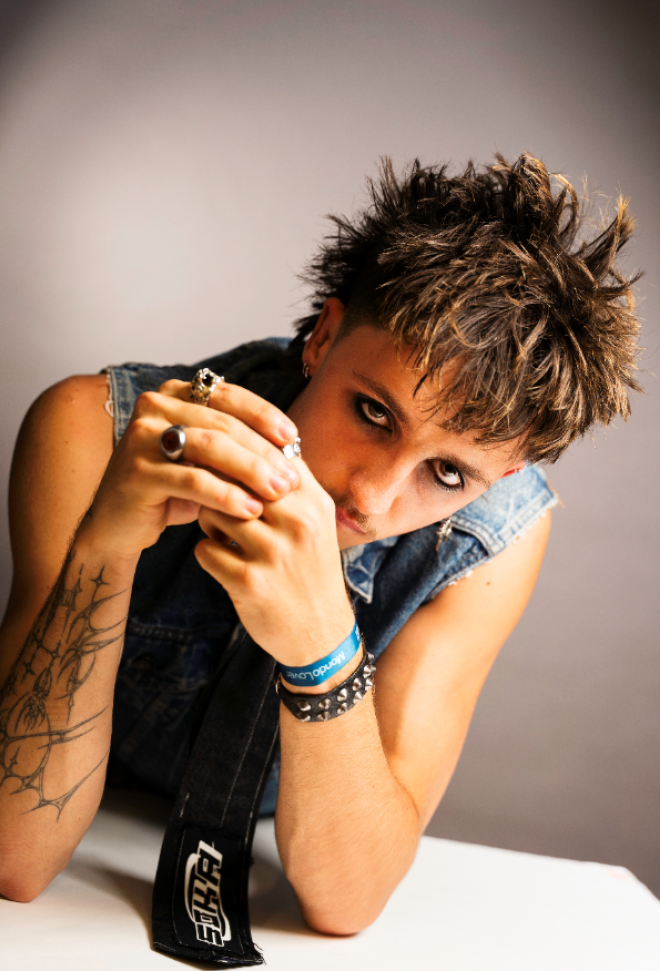
“When I put the tie on, that’s my signal that it’s showtime. On stage, I don’t allow bad energy in. Not because I’m acting, but because people deserve the best possible version of me.”
Performance, in that sense, is temporary. It dissolves as soon as the exchange becomes mutual.
“The performance ends where the emotion starts. When I look up and feel the crowd giving something back, that part is never ironic. Never exaggerated. That part is real.”
RELEVANCE IN A SATURATED SCENE
In a scene where new DJs appear every day, relevance has become an unstable concept. Visibility is easier than ever. Longevity is not. For DAVYBOI, relevance has little to do with volume and everything to do with memory.
“Relevance today comes from more than just playing good sets. It’s about creating something people want to return to.”
When he talks about energy, it is not theoretical. It is rooted in enjoyment, in the visible pleasure of playing music he genuinely believes in. That sincerity becomes contagious.
“When I’m on stage, the crowd reacts because the energy is honest. I genuinely enjoy the music I play, and people feel that.”
From there, the world of DAVYBOI expands outward. Not as a single product, but as a system. Music, visuals, community, storytelling. None of them functions alone anymore.
“You can’t rely on production alone and expect social media to grow by itself. And you can’t rely on social media and hope the music carries everything.”
Relevance, in this context, is about coherence. About allowing every element of the project to evolve together, without shortcuts. A team helps maintain that consistency, but the final measure remains personal and direct.
“At the end of the day, there’s one metric that really matters. If people come back. If they return to the shows, the community, the energy, then you’ve built something real.”
That is what DAVYBOI focuses on. Not chasing attention, but building a place worth returning to.
FROM STUDIO TO STAGE
For DAVYBOI, the studio and the stage do not mirror each other. They exist in parallel, each governed by a different kind of honesty. Where the club is collective, reactive, and volatile, the studio is solitary, inward, and slow. He does not try to import one world into the other.
“The studio and the stage are two completely different worlds for me.”
Inside the studio, there is no crowd to answer to, no pressure to recreate peak-time intensity. Instead, he follows whatever emotional state he happens to be in, trusting that the translation will happen later.
“In the studio, I don’t try to recreate the chaos of a club. I just follow the flow and whatever emotion I’m in at that moment.”
That delay is intentional. The dancefloor is not a reference point during creation, but it becomes the final judge once the music leaves the studio. Energy reveals itself immediately when it is shared.
“The real test is always the dancefloor; people scream, jump, hands go up. If a track falls flat, you feel that just as fast. If the track feels like a filler in the club, then it’s not something I want to release. Not consciously in the studio, but very consciously afterwards. I’d rather keep something unreleased than force a track that doesn’t move people.”
PRESSURE, BALANCE, AND MENTAL CLARITY
The intensity DAVYBOI brings on stage suggests excess, but the reality behind it is closer to discipline. The energy people experience in front of the booth is built elsewhere, in routines that look deliberately unglamorous.
“The only reason I can bring that level of energy on stage is that my off days look completely different. I treat them like recovery training. Clean food, gym, reading, sleep; all the boring things nobody sees, but that make everything else possible.”
Balance, however, does not mean retreat. The dancefloor remains a place of grounding, not temptation. Even when he is not performing, he continues to give something back.
“Going clubbing with my friends is actually a huge part of my mental health. “I’m a party person at heart. The dancefloor is where I grew up, and it still resets me.”
So on nights without obligations, he returns to the crowd rather than stepping away from it.
“If I have a free night, you’ll probably find me somewhere in the crowd, not hiding at home. I know how much of a privilege it is to live a life where I can create my own schedule and make music for a living. That freedom keeps me grounded. It motivates me to take care of myself, work hard, and do everything I can to keep this going for as long as possible.”
When DAVYBOI talks about unity on the dancefloor, he does not frame it as nostalgia. He is fully aware of how fragmented the scene has become, split into micro-genres, aesthetics, and constantly shifting trends. Still, he believes the connection has never been about musical alignment in the first place.
“A shared moment on the dancefloor doesn’t happen because everyone loves the same genre. It happens because everyone drops their guard at the same time.”
When that happens, labels dissolve. People stop categorizing what they are hearing or where it belongs. The room moves as one organism, responding to energy rather than identity.
“If the energy is right, people stop thinking about micro-genres or trends. They just vibe together.”
He does not ignore the obstacles. Phones have changed the way people inhabit clubs, pulling attention outward instead of inward. Presence has become fragile.
“Phones changed the way people experience clubs. That sense of collective release isn’t gone. It just needs more intention. No-photo policies help a lot. The moment people stop documenting, they start feeling again. When the whole room is locked into the same emotion, even just for a few seconds, that’s unity for me.”
VISION AND EVOLUTION
When the conversation turns toward the future, DAVYBOI does not rush to define outcomes. There is no fixation on scale or speed. Instead, he speaks about refinement. About identity becoming audible, not just visible.
“Musically, my next big step is finding a signature sound.”
Energy and presence are already part of how people recognize him. What he is chasing now is a deeper form of authorship.
“People already recognize my energy and the vibe I bring on stage, but I want that same recognition in my productions.”
He points to artists whose tracks announce themselves within seconds, not as competition, but as proof that identity can live inside sound.
“When a track comes on, and you instantly know who made it, that level of identity is something I’m working toward. I know it won’t happen overnight. It’s a long process, and I’m okay with that.”
Beyond music, evolution means learning how to grow without losing orientation. Scale without disconnection.
“Personally and spiritually, evolution for me means staying grounded while everything gets bigger. Keeping my routines, staying close to my community, and not losing the joy that made me start this in the first place.”
When asked to imagine himself five years from now, the image that emerges is not abstract. It is symbolic, almost playful, yet precise.
“If people in the trance scene see a tie and immediately think of me, then I’ve built something iconic. I’d love for DAVYBOI to stand for high energy, honesty, and a bit of craziness. The dancing tie guy who makes people feel alive.”
