


Lars Huismann: Pressure, Space And System Collapse

Lars Huismann is interested in the moment when repetition stops feeling repetitive. Not because something dramatic happens, but because almost nothing does. A filter has been opening for a minute. A delay has shifted almost imperceptibly. Percussion has entered slowly enough to escape notice. Somewhere inside that accumulation of small decisions, the room stops anticipating what comes next.
“A drop gets you a reaction, but a groove that develops patiently gets you surrender, and surrender lasts.”
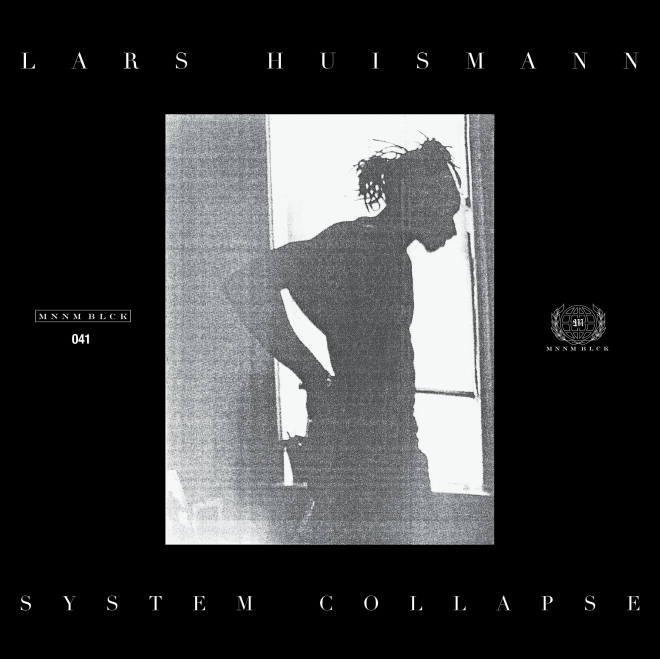
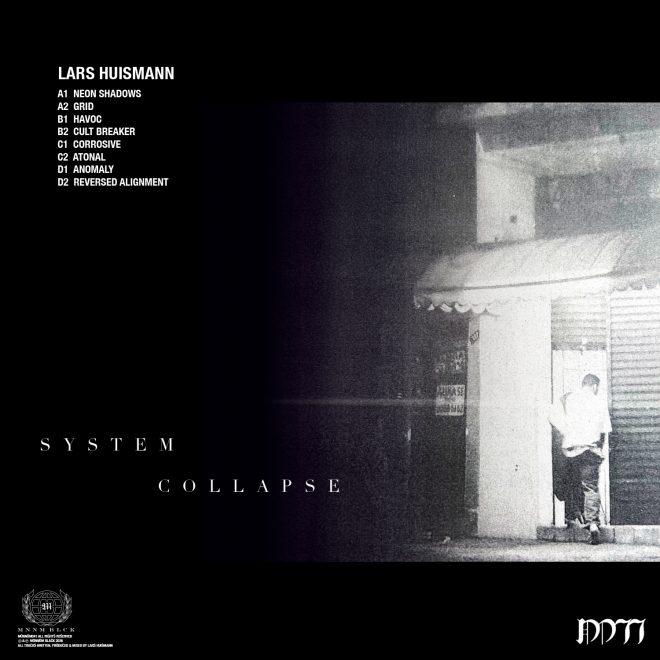
That principle sits deep inside System Collapse, Huismann’s new eight-track release for Monnom Black. Across four vinyl sides, the record moves from the relative openness of “Neon Shadows” towards increasingly physical and austere territory, before “Reversed Alignment” closes proceedings at their most radical. It was not designed as a concept record. Its architecture appeared after the music did.
“I don't start with a concept and produce towards it. I produce, and at some point the material shows its shape.”
Following Mechanized, Huismann simply continued recording while remaining in conversation with Monnom Black founder Dax J. Tracks began responding to one another. One opened a space, another complicated it. Eventually, another eight-track double pack became the obvious format.
The progression is deliberate even if its origin was not.
“The story across it is a descent, more or less. ‘Neon Shadows’ is deliberately first, the friendliest face on the record, so you have something human in your hands before it starts pulling down.”
The middle becomes colder. “Atonal” arrives late as what Huismann calls the record’s deepest breath. Then comes “Reversed Alignment”. There is no attempt to resolve what precedes it.
“It’s probably the most radical piece I’ve put my name on.”
THE SPACE BETWEEN THE KICKS
Huismann started playing drums at eleven, studying jazz, fusion and progressive metal years before techno became his central language. The obvious assumption would be that this rhythmic education transferred naturally into production. He sees almost the opposite.
“Jazz and metal are about accumulation, more vocabulary, more voices, more information. Techno is about abstraction. Less is more, and radically so.”
The useful lesson was not how much he had learned to play, but how much techno forced him to remove.
“A drummer’s reflex is to fill. Techno asked me to erase.”
That process of subtraction remains fundamental to his records. With fewer elements, each one becomes exposed. A hit carries more consequence. Silence becomes structural rather than empty. Huismann compares the difference to sculpture: jazz builds with clay, while techno begins with marble and removes material until the form reveals itself.
It also explains why his music can be fast without feeling overcrowded. His sets tend to sit around 143 to 145 BPM, a range he considers forceful enough to push a room while preserving enough negative space for groove.
“People on a floor don’t actually dance to the kick drum, they dance to what happens between the kicks. Fill every gap and you’ve built a wall. Nobody dances to a wall.”
This concern with space runs through System Collapse. Its pressure rarely depends on oversized drops. Huismann prefers changes that take long enough to become absorbed physically before they are registered intellectually.
“Most of the movement in my tracks is one parameter travelling for a very long time. Nothing announces itself.”
For him, patience is not the opposite of intensity. It is how intensity becomes credible.
“My sets are fast and physical from the first record on. I’m against energy that hasn’t been earned.”
OLD MACHINES, NEW PRESSURE
There is an industrial severity to System Collapse, but Huismann’s methods are less clinically modern than its surfaces might suggest. He records his own sounds, samples and resamples them, uses tape, and continues to draw heavily from dub processing and EBM sequencing.
“Havoc”, perhaps the record’s coldest mechanism, is driven by a single EBM line. “Cult Breaker” and “Corrosive” begin with a classic 303, subsequently processed until its familiar acid vocabulary becomes less obvious. “Atonal” moves in the opposite direction, slowing the pulse and opening the record into dub space.
“Aggression alone is cheap. Anyone can make a hard track. Hard and nothing else is basically cardio. Darkness gets interesting when something alive is moving inside it.”
The warmth comes partly from imperfection. Tape softens edges. Machines drift. Filters do not behave identically on every pass. Dub techniques allow air to remain around harsher material.
“Treat harsh material gently, give it room and air, and it turns emotional on its own.”
This relationship between old equipment, limitation and patience also explains Huismann’s continuing interest in early-2000s techno. He is careful not to romanticise the period or suggest contemporary producers have forgotten how to groove. What interests him are the conditions under which those earlier records were made.
Limited equipment demanded depth rather than endless choice. Hardware imposed its own character. Vinyl slowed the journey between finishing a record and discovering whether it worked in a club.
“The loop between studio and floor was slow, so music got built for repeated listening, not for first impressions.”
The contrast with contemporary production culture is difficult to ignore. Feedback now arrives almost immediately, while music can be judged through fragments before it has lived through a full night.
“Groove is a slow judge. It doesn’t show itself in the first bar, it shows itself deep into a track and even deeper into a night.”
Huismann’s response is not nostalgia. It is to reproduce some of those constraints deliberately.
“When I spend weeks doing nothing but recording and resampling my own sounds, I’m importing those old conditions into my process on purpose. Slower tools force slower decisions.”
SAME MOVEMENT, DIFFERENT CLOTHES
Across Soma, Mutual Rytm, his former LHR imprint and now Monnom Black, Huismann’s records have changed without severing their underlying rhythmic logic.
“You can put someone in completely different clothes and still recognise them from a hundred metres by the way they move. I hope my records work like that. New clothes every time, same movement underneath.”
That movement reaches back further than his current harder material. His first vinyl release, MLLH in 2014 with Martin, occupied housier and dubbier territory. LHR followed in 2015, with Integral Transformation already rooted heavily in dub. Later came EBM, warehouse pressure and early-2000s production references. By 2024’s Catharsis, the darker side had moved decisively forward.
On System Collapse, some of those older instincts return carrying a decade of accumulated technique.
“Same love for dub space, just with everything I learned in between. Full circle, without ever planning a circle.”
His relationship with Monnom Black developed with similar lack of calculation. Dax J first encountered “Cope”, released through Dolly. Huismann later sent him unreleased material without treating it as a formal label pitch. Those tracks revealed a harder side and eventually became Mechanized.
“If I had sat down to write a Monnom record, it wouldn’t have happened. You can hear it when a track was aimed at someone. Something flattens.”
Mechanized sold out and was repressed. More important for Huismann was what the process confirmed.
“Trusting your own taste is the only strategy that doesn’t need updating.”
WHEN THE SYSTEM STOPS
The title System Collapse can suggest technological failure, political fracture or personal overload. Huismann prefers not to decide for the listener.
“A title explained is a title shrunk.”
Still, the atmosphere surrounding the record is specific. He describes a decade coloured by surveillance, declining institutional trust, accelerating technology and public conversation shaped by attention economics. Not subjects he set out to write about, but conditions difficult to leave outside the studio.
“You don’t need to follow the news to feel it. It’s background radiation, and it leaked into these sessions on its own, uninvited.”
He is equally resistant to turning techno into instruction.
“I didn’t make a political record. Message-techno has never convinced me. A floor works precisely because nobody up there tells you what to think.”
The counterpoint arrived while touring the Americas: rooms Huismann remembers as warm, loud and completely present. Against the fragmentation outside, the dancefloor offered a temporary agreement. Everyone entered under the same conditions.
Nothing was solved by it.
That is precisely why the distinction matters.
“A dancefloor is one of the few places where the collapse gets suspended for a few hours. Different people, one rhythm, no feed deciding who stands next to you.”
When the lights return, so does everything outside. System Collapse makes no claim to repair it. The record simply holds the pressure and its temporary release in the same space.
“Nothing outside the room is fixed when the lights come back on. But that contrast is the emotional core of it: pressure outside, release inside, and the music lives in the gap between the two.”
