


Dissolver: A Delusional Fairytale

There is a point at which a club track stops behaving like one. The structure wanders, an idea refuses to resolve where expected, or a sound begins suggesting a world larger than the dancefloor it was built for. Dissolver did not discard those moments. He collected them. On Me, You, Delulu, the misfits became the material.
"I think it was pretty early in the process when I came up with the idea of creating a story from multiple unfinished, multi-genre tracks. Initially, most of them were made with the intention of being club tracks, but sometimes the creative process pushes you in a different direction, and you end up with something that doesn't quite work within that context anymore."
"My goal was to arrange these 'misfits' and expand them in a way that would allow them to function as a whole to tell a story. But not a story like some deep/hypnotic techno DJs would call their, excuse my French, monotonous DJ sets. I mean like a REAL story, a real narrative. Something which allows people to envision what it would look like in their heads."
That narrative was not written before the music. Nor did it appear accidentally afterwards. The two developed together, with the sequencing of the tracks gradually revealing the shape of the story.
"Initially, I had ten tracks for the album. And after listening to them back-to-back in almost every possible combination, I found the definitive order that clicked. In the end, four tracks, aside from the intro and interlude, didn't make the cut."
Once that order appeared, the work became increasingly precise. Dissolver approaches the process through the visual instincts of his design background: first composition, then detail, then repeated correction until the internal logic holds.
"The order gave me like a rough framework of how the story would unfold. And just like with painting, after the initial sketch, I precisely colored everything in until the image became clear. Which mostly involved refining the concept and the tracks, making sure there were no plot holes in the narrative and everything sounded exactly as I intended."
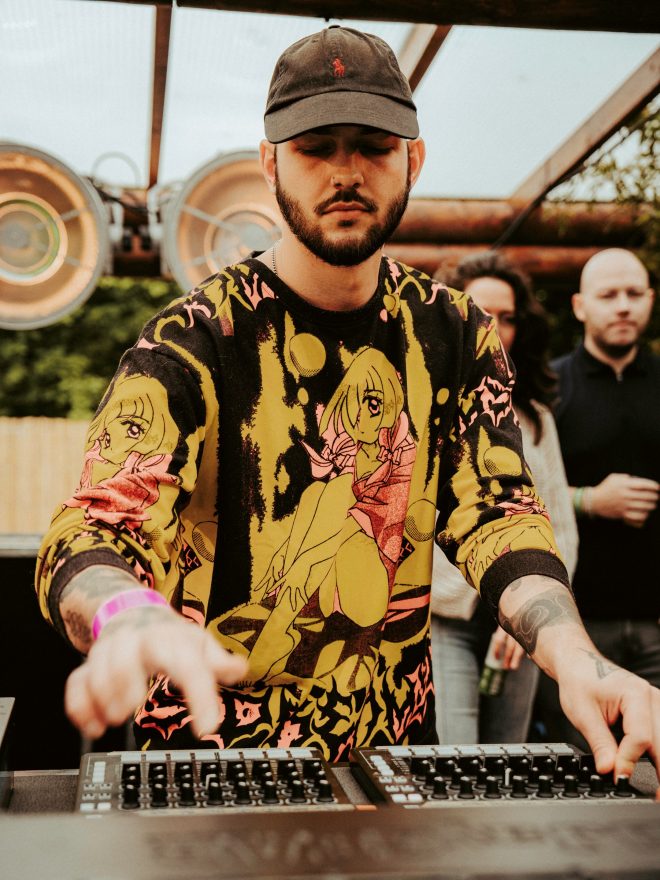
That visual thinking also explains the album's dependence on contrast. Me, You, Delulu moves between beauty and collapse, euphoria and paranoia without trying to reconcile them. For Dissolver, neither side means much without the other.
"I live by contrasts. As someone with a background in visual design, I've learned that nothing stands out on its own. Beauty needs ugliness, happiness needs sadness, darkness needs light. This whole concept of finding contrasts can be applied to pretty much everything and is always destined to make things more interesting."
The same impatience with uniformity shapes his relationship with electronic music more broadly. Techno, trance, UK garage, jungle, and game-derived textures coexist in his work because committing to a single vocabulary would mean removing some of the unpredictability he looks for as a listener.
"I get bored when music or sets are lacking contrasts. It feels characterless and too much like a robot made it. I love it when music or a set is able to do more than just make people move. I want to be surprised, confused, and perhaps even provoked."
One unlikely reference point is Dutch producer Gladde Paling, whose Lowlands 2023 performance remains vivid precisely because humour and absurdity were allowed into the room.
"Never in my life have I laughed more during a DJ set than during his Lowlands 2023 show. The aspects of surprise and not taking yourself too seriously, in combination with unique, funny, well produced music, made it a set my friends and I still occasionally talk about to this day. It was so wildly different from anything else I've heard before, and that is exactly why it left the impression it did."
Difference, however, has practical consequences. Electronic music still relies heavily on genre as an organising system for clubs, lineups, and audiences. Dissolver understands its usefulness without accepting it as a creative instruction.
"As an artist, I don't think anybody should let the construct of genres prevent them from creating what they like the most. Sure, it's harder for bookers to put you in a genre-shaped box, which will most likely result in having fewer bookings than if you were easier to categorize. On the other side, there are no creative walls. The freedom to create and play whatever you like the most is worth more to me personally. That is your true artistic expression after all."
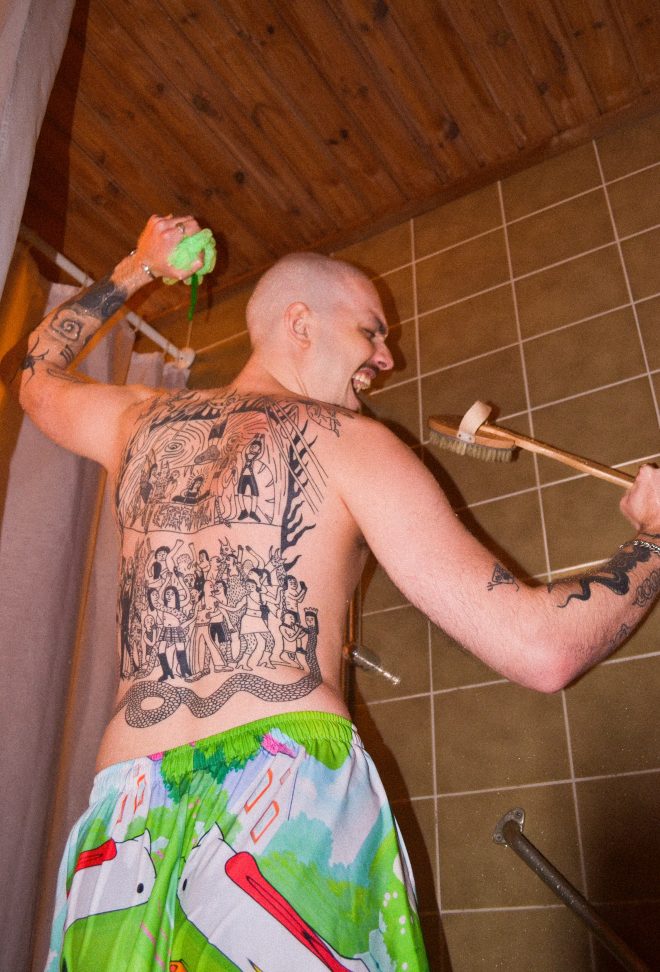
Inside Me, You, Delulu, that freedom is channelled through Hans Bloom, the album's central character. His world is fictional, but the distance between character and creator is deliberately unstable.
"Even though Hans and the story are fully fictional, the things he goes through are VERY loosely based on real events of my own life, minus the crime part. It's as if you took the events that happened in real life, put them in a blender, added two shots of despair and existentialism, a spoonful of exaggeration, a drop of shroom extract, mixed it thoroughly, and served it in a champagne glass."
The humour matters because the territory becomes darker. Psychosis, addiction, crime and altered perception appear throughout the narrative, but Dissolver's intention was immersion without romanticisation.
"The goal was never to romanticize addiction or psychosis, but to sonically portray the confusion, instability and emotional distortion that can come with those states. From a conceptual vision it has some similarities to Requiem for a Dream: it doesn't glorify those themes, but it also doesn't look away from them. It puts you inside that world and lets you experience both the attraction and the destruction that come with it."
Protecting that world meant accepting that some tracks would lose conventional dancefloor efficiency. Here, narrative takes precedence.
"100%. Like I said in the beginning, most of these tracks already didn't fully fit the context to be used as club tracks. But it's exactly those tracks that gave me the idea to do something completely different with them. I think electronic albums become way more interesting when they allow themselves to function as actual musical stories instead of just collections of usable tracks."
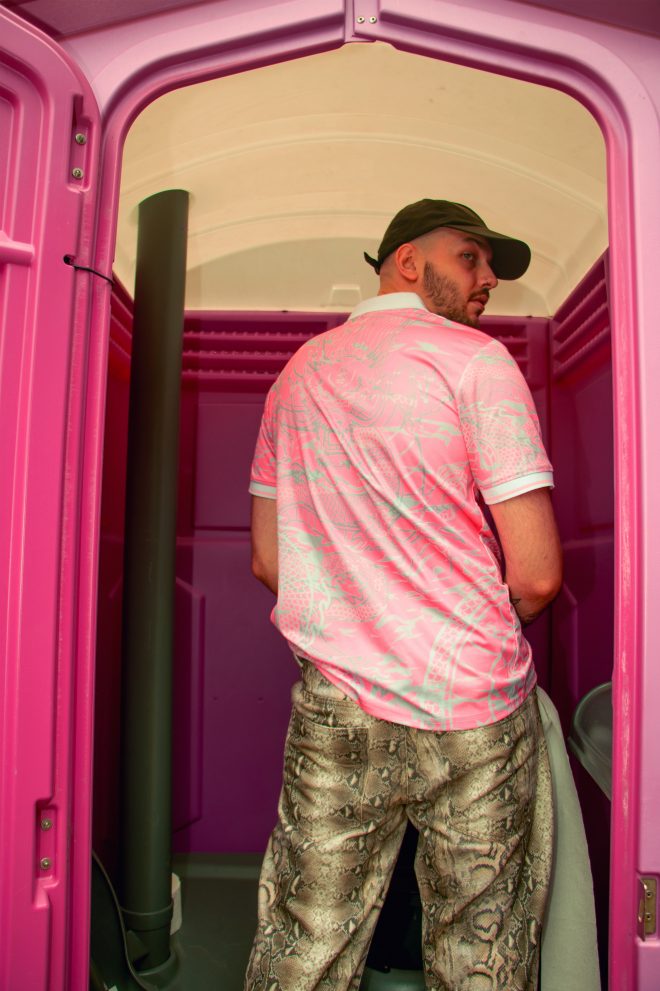
Games naturally inhabit that story. Dissolver has long sampled and referenced them, and Me, You, Delulu folds their language into its own reality without turning the album into an exercise in nostalgia.
"The lead melody of the third track on the album, '2 Fast 2 Soon', is inspired by the melody of one of the final bosses of Persona 5, the intro contains a sample of GLaDOS from Portal and from Sans of Undertale. And also, at one of the pivotal points of the album, when Hans acquires a gun, he does so by opening a Fortnite chest."
Yet those references are details rather than the source of the concept.
"These gaming samples, as well as the memorable voice recordings from my friends in the intro, are more like personal, little gimmicks instead of concrete influences for this project. It was pretty much my own imagination and experiences that sculpted the idea and atmosphere for the album."
That imagination now moves beyond sound. Alongside the album comes a physical fairytale book, turning Hans Bloom's descent into something that can be held, read, and seen.
"Because releasing a fairytale without a physical book feels incomplete to me. This is a story where I put so much time and effort into making it work that I want to release it exactly the way I intended to."
The object introduces one final contradiction. While the narrative moves through dystopian territory, the book adopts the language of something far more innocent, with original illustrations by Amsterdam tattoo artist @mvttys.
"While the story itself is dark and dystopian, the book on the other hand reads like a happy Dr. Seuss story. I also love having a physical aspect to support the audio, because it changes the way people interact with the story. Holding a book, reading the text, seeing illustrations. It creates a completely different relationship with the project than if you only were to listen to it."
That insistence on sustained attention inevitably places Me, You, Delulu against a culture increasingly organised around fragments. Dissolver has little interest in disguising his frustration with an underground ecosystem reshaped by algorithms, visibility and the economics surrounding both.
"I strongly oppose the current digital industry and its fake values. Instagram and TikTok have turned the underground techno scene into a full-on capitalist breeding ground. There are so many extremely talented, passionate artists and producers who don't care about the algorithm, who would never get the same opportunities because everything is about social media and money nowadays."
Me, You, Delulu does not propose a solution to that system. It simply refuses to organise itself around its demands. A strange record, a fictional character, a physical fairytale and a collection of tracks that failed, productively, to become what they were originally supposed to be.
For Dissolver, that refusal is the point.
"All I hope is with releasing this unconventional project, I can inspire some people to do the same. To stop conforming to genres and the algorithm. Just be the outcast without trying to fit in. Allow your creativity to roam free and express yourself in a way that only you can.”
