


SANTA SALUT
The ritual and the riot
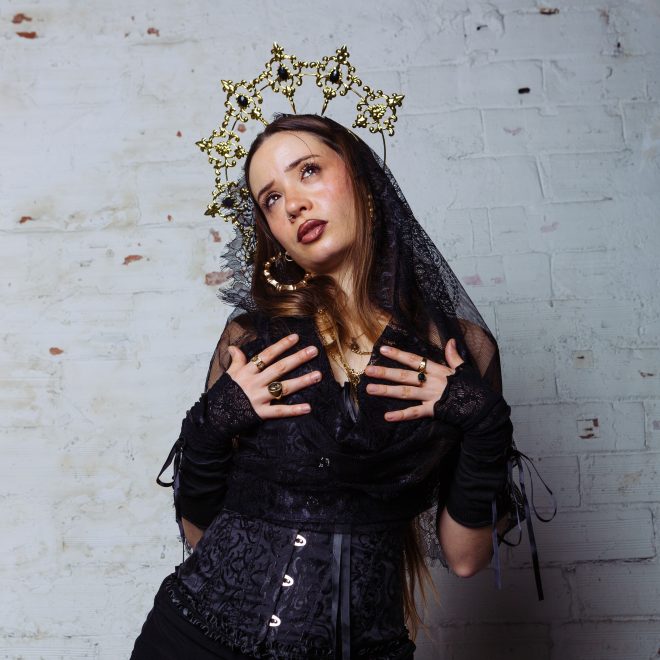
There is a moment in every Santa Salut set when the atmosphere tightens, as if the room suddenly remembers its own heartbeat. The BPM is already running high, the booth is vibrating, yet something shifts in the crowd's collective posture. It happens when she lifts the mic and lets her cadence slip between the kick drums. The border between rap’s narrative force and the physical gravity of hard electronic music dissolves. Two cultures that once stood apart now inhabit the same pulse.
She has never treated this convergence as a reinvention. It is a return to something she has carried since childhood in Catalonia, shaped by radio stations that broadcast electronic culture into the domestic quiet of adolescence. What looks like a genre pivot is, for her, simply the moment when the path loops back to its origin.
“We began opening space for electronic music from the very beginning of the project. We freestyled depending on the room, the crowd, the energy, and suddenly it clicked. A DJ played a techno track, and I started rapping. It felt natural because I grew up listening to Maxima FM, Flaix FM, sets from Defqon1, Tomorrowland, and makina parties. It has always been part of my journey.”
That instinct continues to define her present. The shift into hard techno, schranz, and hardcore was not an escape from rap, but a widening of her emotional vocabulary. Her voice carries the weight of lyricism into a sonic field built for velocity, while the booth gives her something rap rarely allows: space to implode and expand in the same breath.
THE BALANCE POINT
The booth is a threshold, and Santa Salut treats it as such. She enters it not as a rapper trying to fit into club culture, but as someone who understands that both traditions emerged from the same need to rewrite the rules of belonging. Her sets bridge two energies that share a political ancestry.
“Electronic music and rap come from the same places. They come from people who were outside the system, people who wanted to express themselves and speak up in their own way. I tell myself there are no rules, that my art is free and just as valid as any other. I like creating an atmosphere where everything blends and becomes a little punk, a little chaotic, always honest.”
She treats references as coded gestures. Madonna, The Prodigy, rap classics, queer culture, Catalan identity. They appear in fragments across her sets like clandestine signals. Sampling becomes a political act, a way to place her lineage inside a sonic world that did not historically make room for it. Each transition is an argument, each vocal entry a declaration of authorship.
After nearly ten years of work, Santa Salut observes a scene that is evolving rapidly, both sonically and socially. Electronic music has grown heavier, faster, and more extreme. The spaces around it have become more inclusive, though not without friction. The shift, she notes, was earned, not granted.
“We have been fighting for our place by showing our talent and proving things through action. More spaces now welcome different identities, and we are building something powerful together. My vision carries my femininity and you can feel the difference when a woman or a feminine man is playing. The way I play Schranz is not the same as a man does, and that difference makes the culture richer.”
Her sets carry these nuances in subtle, decisive gestures. A melodic line cut into a hard drop, a rap chorus resurfacing amid a 170 BPM barrage, a queer-coded reference slipped into a room that doesn’t expect it. The booth becomes a site where cultural threads collide and fuse, but never blur.
Despite the spontaneity that defines her stage presence, Santa Salut is not an artist who improvises blindly. Her sets obey an internal logic, one built around contrasts and emotional architecture.
“I like to visualise what I want to do before going onstage. I imagine if I want to start softer or come in hard, where I want a reference to appear, when I want to sing, when I want tension. I divide the set into parts. The only thing I know for sure is that I want to finish with madness, with hardcore, with something so raw that it becomes funny. I love that final sprint.”
Her performances feel ritualistic because they allow instinct and preparation to coexist. She builds routes for the audience but leaves room for chaos to erupt at precisely the right moment.
Touring has made her relationship with language and energy more complex. Rap in Catalan and Spanish travels differently across cultures, and yet audiences across continents have responded with a unity that still surprises her.
Greece stands as a turning point. Her memories of Athens and Thessaloniki carry the intensity of a threshold crossed, a realisation of scale and resonance. The crowd did not wait for translation; they understood her through force, presence, and rhythm.
“The first time I went to Greece was one of the craziest experiences I have had. We played for more than a thousand people in Athens and had incredible energy in Thessaloniki. As someone who performs rap in Catalan and Spanish, it is special and rare to see language no longer be a barrier. As a DJ, I am still new, but playing at Fabrik Madrid, performing at Nexus festival, or doing a B2B with Gea at Spook, mixing makina at such an iconic place, felt like medals. I feel blessed.”
These places formed an emotional map of her artistic growth, each one adding a different layer to her sense of self onstage.

THE GROOVE AND THE SHADOW
Her album Queens of Groove opened another dimension of Santa Salut’s artistry: introspective, soulful, rooted in instrumental musicianship and the warmth of late-90s and early-2000s textures. It is a body of work shaped not by walls of kicks, but by narrative weight and emotional contour.
“‘Queens of Groove’ is a serious album with instruments and real musicians. It embraces the groove of the 90s and 00s, inspired by The Fugees, soul, and jazz. The lyrics are introspective. They talk about anxiety, fear, courage, and the pride of being a woman who knows herself.”
On 11 December, she released an EP featuring remixes of Queens of Groove, along with an unreleased cut produced by Fectro. The project gathers three reinterpretations by Caravel, Teri Makaisih, and Fectro, with Gea delivering a sharp rap feature. It also introduces the inedit No Me Mires, a track that extends the album’s emotional vocabulary into something bolder and more distant, as if viewed from a new altitude.
If her live sets are storms, Queens of Groove is the moment the clouds open. Not softer, but clearer. Not slower, but deeper.
Her recent collaborations, including Andrés Campo and Caravel, signal a new sonic openness. They offer spaces where she can test versions of herself that daily life rarely allows.
“When I collaborate, I like to show a version of me that is not shy, that is raw and explosive. I search for femininity inside electronic music when I write, when I choose flows, when I enter a producer’s world. That is what I look for in collaborations.”
These partnerships become dialogues between energies, a way to mirror parts of her identity that only reveal themselves under extreme BPMs and shared authorship.
Her roots remain in the culture of Barcelona’s streets, free parties, mountainside raves, and improvised sound systems. Rap shaped her discipline. Electronic music shaped her nights. The hybrid emerged naturally from the social landscape that formed her.
“Where I come from, electronic music was always with us. We grew up with sound systems, raves in the mountains or the beach, industrial sites, and free party culture. During the day, we listened to rap, and when night fell, we went to electronic parties. A friend DJed or we connected a speaker. It is all connected and that cultural mix inspires my performance. This is me as this is us.”
Her shows are, in essence, translations of that ecosystem. Not representations, but enactments.
TERRITORIES OF THE FUTURE
Santa Salut’s curiosity aims toward London and its bass-driven ecosystem. Drum and bass, bassline, MC culture, the call-and-response between voice and rhythm. These sounds suggest a future direction grounded in both history and experimentation.
“Lately, I am very interested in bass music. Living in London showed me a little and now I want to return, learn more, and understand how MCs and DJs work together. Drum and Bass and Bassline are so fun and powerful that I already include them in my sets. Schranz is a great bridge for mixing genres and rap will always be the base. That is my sign.”
Her next steps are not linear. They are transversal.
Ambition, for Santa Salut, is measured in movement rather than hierarchy. She wants new scenes, new communities, new nights that rewrite her internal map.
“I want to play outside Spain. I do not care where or with whom. I want to meet DJs, singers, promoters, and people who build culture in each place. Playing a full hardcore or raw set in a festival in the Netherlands would be a dream. And going to a bassline party in the UK, because in Spain it is not so popular, is something I really want.”
Her horizon is wide open.
Santa Salut stands at a rare intersection, carrying rap’s linguistic precision into a club ecosystem built for speed, while bringing the extremity of hard electronic music back into rap’s orbit. She embodies both histories without diluting either.
Her work is a hinge.
A ritual.
A riot that keeps expanding.
