


Cinthie: The Music That Remains

Thirty years after her first club set, Cinthie has watched house music grow from record shops and underground rooms into an industry built for global visibility. Yet her convictions remain: records matter, communities need physical spaces and independence has value. With a second album underway, 803 Crystal Grooves active again and Elevate continuing in Berlin, she is protecting what still feels real.
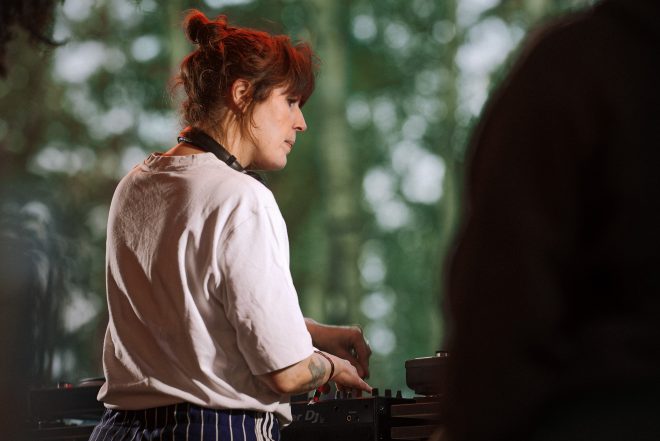
Cinthie remembers being too nervous to look at the crowd. It was 1997 in Saarbrücken, near the French border, and she was 17. Booked for the opening slot at a local Carnival event, she ended up playing four hours when the next DJ fell ill. There were no USBs or visual waveforms, only records and an unfamiliar sound system.
“It was my first gig, my first time on a big system and, of course, I only had records. I was too scared to look at the crowd, but I managed somehow. Afterwards, Frankfurt legend Marc Spoon said, ‘Well done.’ That made me believe in myself.”
Next February marks 30 years since that night, an extraordinary span in a culture organised around the new. Formats return, clubs close, technology transforms DJing and social media reshapes artists’ roles.
At first, DJing did not look like a viable profession. Cinthie collected records while planning something “serious” and studying software development.
“Who would have thought? In 1997, DJing full-time was not seen as a real job. I treated it as a hobby, but life had other plans.”
Those plans brought international touring, Elevate, 803 Crystal Grooves, an album, a DJ-Kicks mix and years of releases. Her younger self would be proud, though she wishes that teenager had seen a woman further along the same road.
“Not bad for a girl from a small town who just wanted to collect and play records. I only wish I’d had a role model like that.”
Her career was not accidental in the sense of being effortless. The accident was discovering that something pursued before she considered it a career could become a life.
BEFORE THE CAREER CAME THE CULTURE
Cinthie’s relationship with house music is inseparable from 1990s Germany. After the Berlin Wall fell and the Cold War ended, house and techno soundtracked a sense that the rules could be rewritten.
“The ’90s were crazy. The Wall came down, the Cold War was over and there was this feeling that we could change the world. House and techno were the soundtrack, uniting people on the dance floor like never before.”
Berlin’s unlimited opening hours, undocumented dancefloors and anonymity created freedom. Some of that city has disappeared, but Cinthie retains its “underground mentality.”
What changed most, she argues, was not the equipment but the motivation. DJing was no obvious route to money or status: fees were poor, records were heavy and DJs might still clean the booth after playing.
The growth of electronic music, and then the internet, changed those expectations.
“The internet suggests you’re only a good DJ if a designer brand sponsors you, you fly business class or by private jet and have attractive people in the booth. Social media mostly shows the fabulous life of a successful DJ, and people want the same.”
Her point is not that musicians should reject comfort, but that the image of the profession can arrive before the obsession that once drew people towards it.
“I wish it were more about the music. What changed is the ‘why’: are people doing it for money and fame, or for that deep connection with music?”
Her hope is not for a return to 1997, but for space to remain for those drawn to club culture’s outsider spirit.

A LIFE THAT HAD TO MAKE ROOM
Motherhood made balancing life and career unavoidable. Without substantial support nearby, touring while raising her daughter almost drove Cinthie to abandon music.
Finding a workable arrangement challenged the assumption that women must eventually choose between parenthood and ambition.
“Women are often told they must choose between work and family, but that isn’t true. You need better planning or different solutions from someone with a nine-to-five job. Everything is possible.”
Her daughter is preparing to spend six months in Seoul. They have never been apart for more than two weeks, and being the one left behind has sharpened Cinthie’s definition of success.
“Success means balancing both without exhaustion or losing my passion. Burning out after heavy touring can look like success, but mine is being respected by the right people; especially those I admire.”
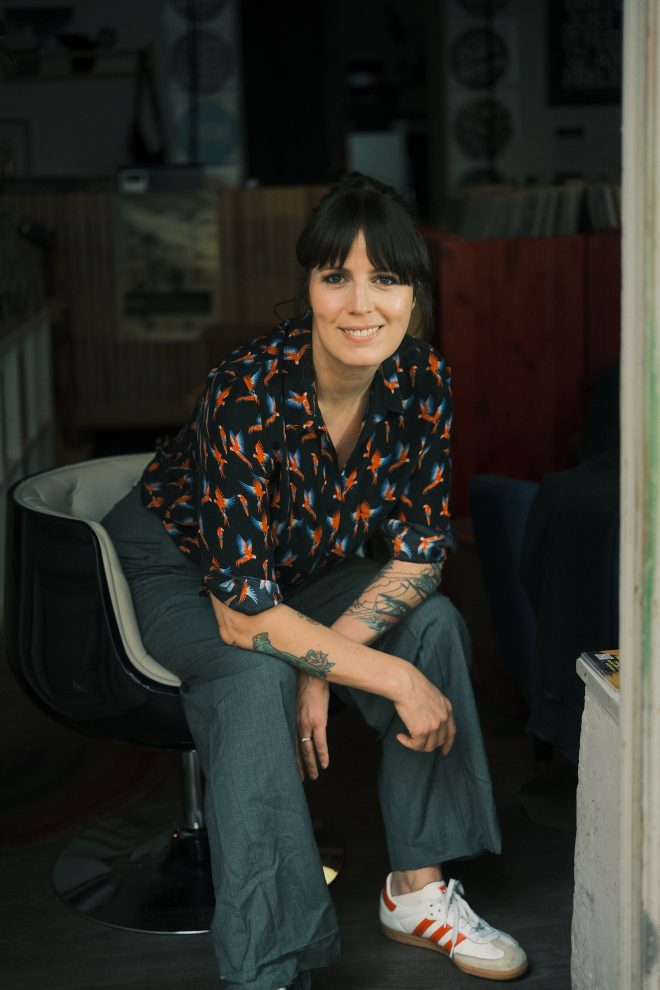
That preference for durability extends to Elevate, her Berlin record store. Asked what a physical shop offers that an algorithm cannot, she answers immediately.
“The answer is very simple: service and community.”
A shop enables unpredictable encounters: a recommendation, an unknown delivery or a conversation that expands taste beyond previous choices.
“What I love most about having a physical record store, and no, it’s not the pre-drinks before my Panorama Bar gigs; is the community: the friends we made and the friendships between customers. That social connection matters most while tech companies tell us to live in a virtual world.”
Elevate is less an exercise in vinyl preservation than an argument for physical presence. The records bring people in. What happens between them is the part technology still struggles to reproduce.
The same instinct guides 803 Crystal Grooves, active again after pandemic-era pressing delays. Her criteria are direct: “great DJ food from nice artists.”
“I want badass tracks, but the vibe also has to be right. I’d never release music by a not-so-nice person. Be open-minded when approaching labels, get out of your comfort zone and don’t imitate what they’ve already released.”
BACK IN THE LAB
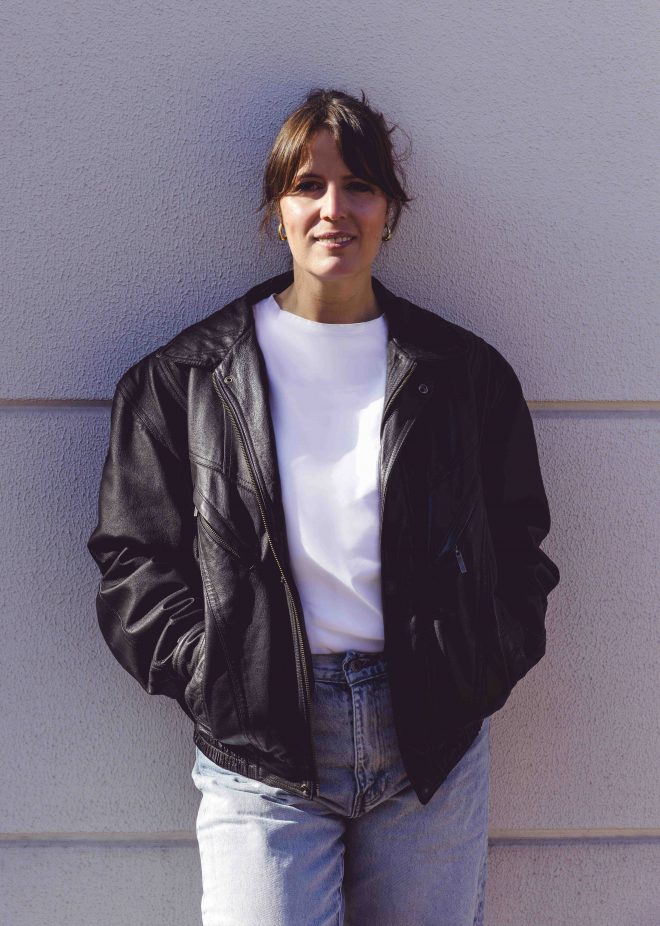
Deep into her second album, Cinthie is on a creative high. While her debut, Skylines - City Lights, explored house music’s different sides, independence now lets her move beyond expectations.
“An album can show things nobody expects from you. The first covered all sides of house music; I believe the second will take me to the next level as a producer, though the audience can decide. I’m enjoying switching off the outside world, putting my thoughts into music and clearing my mind.”
Her production journey began with an Atari, Cubase 2.0 and one Yamaha synth. Completing her debut decades later gave her confidence despite COVID disrupting its release.
“I never thought I’d release a full album after starting with one synth and absolutely no idea what I was doing.”
Experience has taught her when independence becomes counterproductive. Since last year, Steve Bug has been doing her mixdowns wo she can focus on writing.
A remix request from Soul II Soul tested that confidence. Reinterpreting “Missing You,” music tied to her own journey, brought pressure.
“I was first excited, then I tried a few things, wasn’t happy, got demotivated, almost threw everything out of the window and then started again. This happens quite a lot. Usually the first version is meheee, but good things take a while. When I sent them the result, they sent back an email with, ‘Wow, what a remix!’”
After 30 years, records can still make her nervous. That may be the more meaningful measure of longevity.

THIRTY YEARS, WITHOUT THE FULL STOP
As Cinthie approaches three decades behind the decks, her second album remains unfinished, 803 Crystal Grooves is moving again, Elevate is developing and her daughter is preparing to live thousands of kilometres away. The future looks less like a victory lap than another adjustment.
“There will be changes in the coming months, but I’ll remain the same: focusing more on making music while still doing what I love most, sharing it with others.”
The infrastructure around her has become larger than the teenager in Saarbrücken could have imagined: a shop, a label, records of her own and decades of touring. Yet beneath it remains the original gesture, finding music and wanting somebody else to hear it.
Thirty years ago, she stood behind an unfamiliar sound system, afraid to look up and playing twice as long as planned. She kept going because house music had already given her a reason to stay.
MY THOUGHTS
The infrastructure around her has become larger than the teenager in Saarbrücken could have imagined, but Cinthie is entering a period in which expansion is not the only measure of movement. The second album is taking shape without the need to repeat the first. 803 Crystal Grooves is active again. Elevate is preparing its next developments. And, away from music, the rhythm of home is about to change when her daughter leaves for six months in Seoul.
After decades spent being the one who leaves for airports, clubs and another city, Cinthie will find herself on the other side of that departure. She admits the separation may be one of the biggest adjustments yet. There is pride in watching her daughter inherit the same curiosity about the world, alongside the difficulty of learning how to give that independence space.
Perhaps that is what 30 years ultimately look like from inside them. Not permanence, but repeated adjustment. Learning when to hold onto something and when to let it move without you. Knowing which parts of the past deserve protecting without requiring the present to resemble it.
Cinthie has no interest in recreating 1997. The Berlin she entered has changed, the profession has changed, and so has the life around it. What she has kept is simpler: the instinct to find a record, understand what it can do in a room, and pass that feeling to somebody else.
Thirty years ago, she stood behind an unfamiliar sound system, afraid to look up, unexpectedly playing twice as long as planned. Now there are albums, a label, a record shop, countless flights, and another generation beginning its own journey away from home.
The movement continues. The reason for it has barely changed.
