


KYRA KHALDI
Multiplicity, emotion and the freedom to move between worlds
Origins in Sound
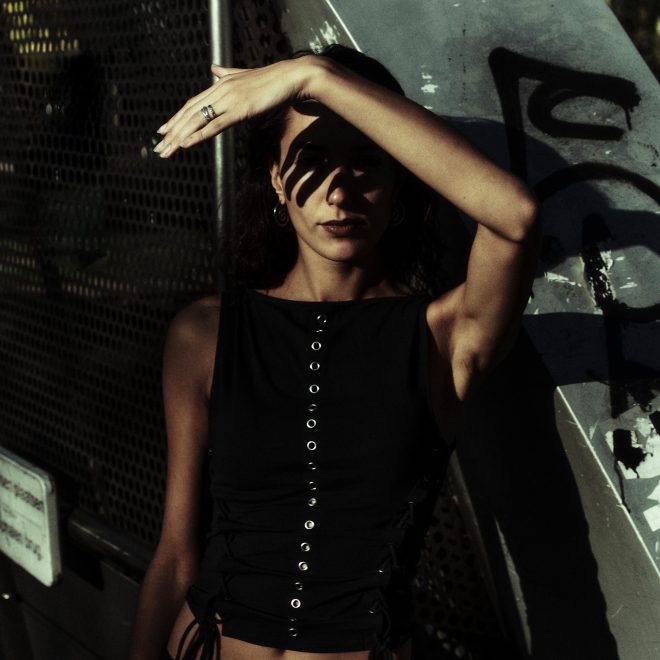
For Kyra Khaldi, electronic music was never a distant discovery waiting somewhere in the future. It was simply present, woven into the atmosphere of everyday life long before it became a professional path. Growing up in a household where nightlife and dance music were embraced rather than questioned, she encountered house records and DJ mixtapes at an age when most people are still forming their first musical memories. CDs filled with club tracks played alongside pop radio in the car and at home, creating a sonic environment where the boundary between mainstream and underground barely existed.
One of her earliest memories captures the innocence and strange poetry of those early encounters with house music. A repetitive vocal phrase echoed through the speakers during family road trips, a phrase that her younger self could not yet fully understand. She and her sister misheard the lyrics as “Leo is dood,” imagining that the song was referring to a cat named Leo belonging to family friends in France. The misunderstanding became a private joke they sang repeatedly at full volume, turning an anonymous club track into something playful and personal.
Those early experiences planted the seed of something deeper. Because electronic music surrounded her from childhood, it never felt distant or intimidating. Instead, it functioned almost like pop music in her imagination; something you could sing along to, reinterpret, and inhabit in your own way. That playful engagement with house music would later become a defining element of Khaldi’s artistic identity, blurring the lines between dancefloor functionality and expressive storytelling.
Her entry into DJing happened somewhat unexpectedly. After discovering an online course by DJ Abstract, she began practicing regularly during the day at Disco Dolly, where she gained access to professional equipment and the chance to refine her skills. The experience proved formative, not because she initially saw herself as a future DJ, but because it allowed her to translate a lifelong love for nightlife and music into a practical craft.
“I think my interest in DJing grew more out of a deep love for nightlife and music than from actually seeing myself as a DJ.”
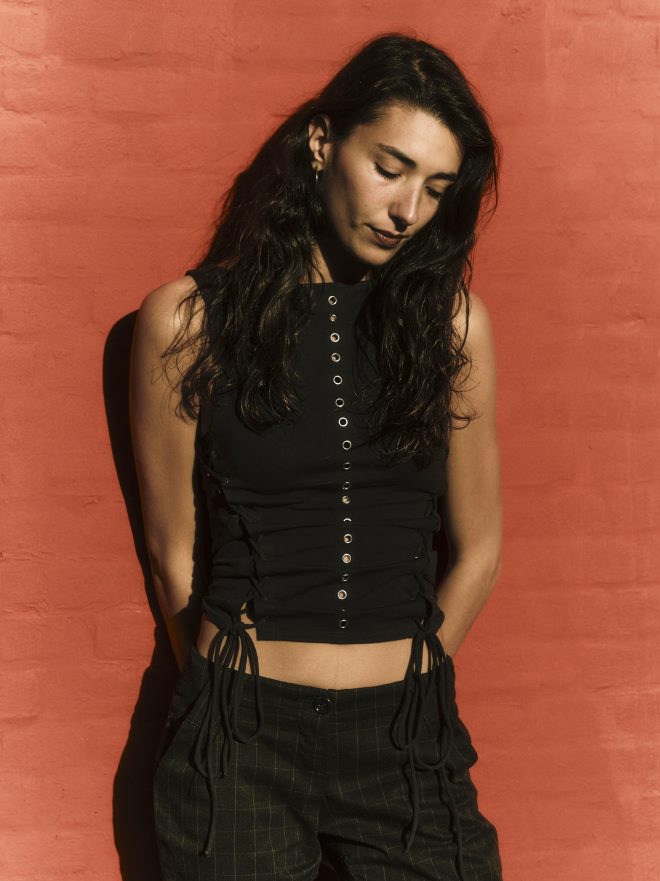
In those early years, however, the industry did not immediately recognize her connection to underground club music. Many of her first bookings leaned toward pop, R&B, and Afro-oriented sets, genres that demanded versatility but left little room for the four-on-the-floor pulse she felt increasingly drawn toward. Rather than rejecting those opportunities, she treated them as creative challenges, discovering ways to weave her own sensibility into different musical environments.
Gradually, though, the pull of underground sounds became impossible to ignore. Artists like FS Green, Jarreau Vandal and Full Crate provided a temporary bridge, offering eclectic dance music that balanced club rhythms with accessible melodies. Yet even that space began to feel limited. Compared to the vast universe of house and techno, with its endless subgenres and decades of evolving aesthetics, the field she was operating in began to feel increasingly small.
“House and techno felt like an infinite universe. I never ran out of things to discover.”
The shift toward a deeper club identity happened slowly, aided in part by the reflective pause created by the global pandemic. During that time Khaldi was able to rethink how she wanted to present herself, gradually repositioning her project toward house, techno and progressive music. Even today, she remains resistant to rigid categorization, preferring to move freely between styles rather than locking herself into a single sonic label.
Multiple Identities, One Artist
If Kyra Khaldi’s career seems difficult to classify, it is partly because the project itself exists across multiple creative dimensions. Alongside her DJ sets, she performs a live show built around Ableton, synthesizers and vocals, while also developing a separate pop-oriented alter ego known as Sensa. Rather than functioning as competing personas, these identities represent different expressions of the same artistic core.
Kyra Khaldi the DJ operates primarily in dialogue with the dancefloor. Her sets unfold intuitively, responding to the atmosphere of the room and the collective energy of the crowd. The process is collaborative by nature, with each transition shaped by the subtle feedback loop between artist and audience. In this space, spontaneity and instinct play a central role.
The live project, by contrast, moves toward something more narrative and conceptual. Here Khaldi steps beyond the mechanics of DJing and into a more immersive performance format, incorporating vocals, poetic lyrics and visual elements that expand the emotional palette of the music. The structure of these performances is more defined, often built around a storyline or thematic concept that unfolds over the course of the set.
“When I perform live, it’s really focused on listening. It’s a more diverse experience, often with visuals playing an important role.”
The emotional tone of the live project is noticeably different as well. Where her DJ sets are designed to interact with the shifting dynamics of a dancefloor, the live show invites the audience into a more intimate and reflective space. Singing her own lyrics introduces a vulnerability that rarely appears in traditional club environments, transforming the performance into something closer to a concert than a DJ set.
Yet even within this complexity, Khaldi sees continuity rather than fragmentation. The various projects are not separate careers but different chapters within the same narrative. Many of the sonic elements present in her dance productions reappear in the live material, albeit slowed down, reshaped or placed within a different musical context.
The pop alter ego Sensa represents yet another dimension of that story. Emerging from a renewed desire to sing and perform more theatrically, Sensa reconnects Khaldi with the expressive energy she experienced as a child. Before studying at the conservatory, she trained at the Lucia Marthas Institute for Performing Arts, where singing, dancing and stage presence formed a central part of her education.
Over time, however, she began to retreat from that spotlight. As a teenager she adopted a more reserved posture, placing herself in the background rather than openly pursuing attention or recognition. Creating Sensa became a way to reclaim that earlier confidence, allowing her to explore pop aesthetics and visual storytelling without the expectations attached to her DJ identity.
“My alter ego is basically me, but without the baggage. It’s me as a child, grown up without changing to fit in.”
Architecture of the Dancefloor
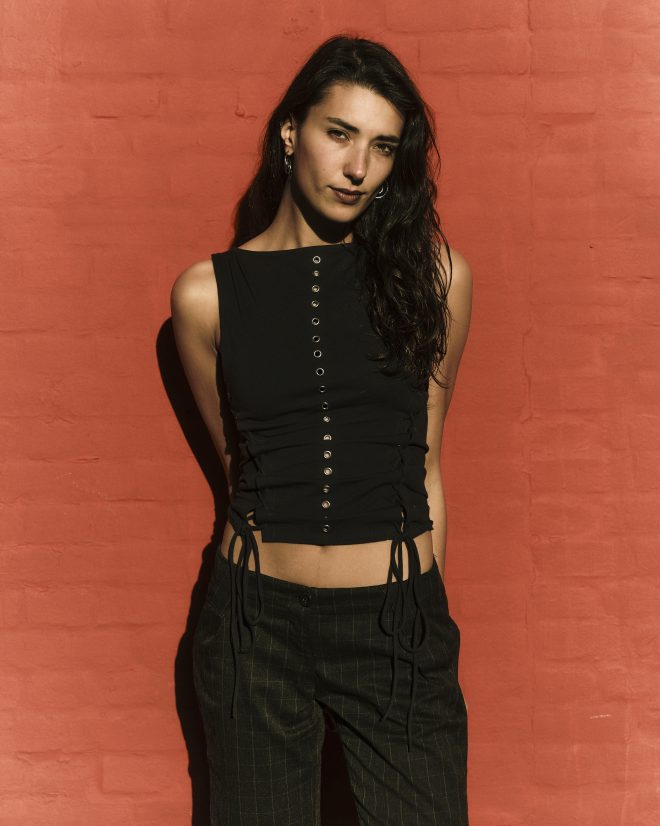
When Kyra Khaldi builds a DJ set, she rarely thinks in terms of rigid genre categories. Instead, her approach revolves around contrast and narrative flow. Tracks are selected not only for their individual impact but also for how their emotional atmosphere interacts with the surrounding music. Warm melodies may give way to darker textures, while driving rhythms gradually dissolve into more reflective passages.
This constant interplay between opposing energies forms the structural backbone of her sets. Rather than maintaining a single mood throughout an entire performance, she allows the music to move through different emotional states. The result is a dynamic listening experience that evolves gradually, guiding the audience through shifting landscapes of tension and release.
Often Khaldi begins with a rough conceptual outline before stepping into the booth. Certain tracks are chosen as anchor points within the set, functioning as narrative markers that help steer the overall direction. These pieces act as a “red thread” running through the performance, providing coherence even as the music explores contrasting atmospheres.
“I always work with contrasts. Tracks that differ in energy and atmosphere keep a set more interesting and full of dynamics.”
Transitions between these sonic territories require careful timing. Khaldi frequently selects tracks that contain internal contrasts, pieces that blend melodic warmth with darker undertones. These hybrid records allow her to shift the direction of a set without abrupt disruptions, gradually introducing new textures before fully committing to a different mood.
At the same time, intuition remains central to the process. Even when she has planned a specific narrative arc, the reaction of the crowd can alter that trajectory in an instant. If a room responds strongly to a particular atmosphere, she may choose to stay within that emotional space rather than forcing a pre-planned transition.
This balance between preparation and improvisation reflects a lesson learned over years of performance. Earlier in her career Khaldi sometimes felt pressured to prioritize crowd expectations above her own musical instincts. With time, however, she has grown more confident in maintaining her personal artistic direction while still remaining responsive to the room.
The Vulnerability of Live Performance
While DJing remains the most visible aspect of Khaldi’s career, her live performances open a different emotional dimension altogether. Singing in front of an audience introduces a level of vulnerability that cannot easily be replicated behind a DJ booth. The voice, with all its fragility and unpredictability, becomes an instrument that exposes the performer in real time.
For Khaldi, this vulnerability is precisely what makes the format so powerful. Because the vocals are delivered live rather than pre-recorded, each performance carries an element of risk. Nerves can influence tone and pitch, and emotional intensity can reshape the delivery of a lyric in unexpected ways.
“Live vocals are often perceived as something vulnerable, and because this is still quite new for me, nerves can strongly affect my voice.”
That vulnerability also reshapes the relationship between performer and audience. Rather than observing a DJ manipulating tracks behind a booth, listeners encounter a musician actively exposing her emotional world on stage. The atmosphere becomes more intimate, sometimes even fragile, inviting a deeper form of connection.
One particularly poignant example occurred during ADE Lab, where Khaldi performed a piece dedicated to a close family friend who had passed away years earlier. By coincidence, the anniversary of his passing fell on the day of the performance. In tribute, she dressed entirely in white, echoing the friend’s habit of wearing that color, and wrote lyrics inspired by his memory.
Moments like that illustrate the unique expressive potential of the live format. While a DJ set can guide collective energy on the dancefloor, a live performance can hold space for more personal narratives, transforming electronic music into a medium for storytelling and remembrance.
Knowledge, Experimentation and Growth
Khaldi’s development as an artist has also been shaped by her academic training. After studying electronic music at the conservatory in Haarlem, she graduated with a deeper understanding of harmony, composition and sound design. The experience did not diminish her experimental instincts; rather, it expanded the range of possibilities available to her.
In the early stages of learning production, experimentation often occurred without a clear theoretical framework. Occasionally that freedom produced unexpected and interesting results, but it also meant that many musical ideas lacked structural coherence. Studying music theory introduced a new layer of discipline, helping her understand why certain harmonic decisions created specific emotional effects.
“People often say that you first need to understand music theory before you can step outside the lines and actually know why you are making those musical choices.”
Like many musicians, Khaldi eventually experienced the opposite challenge as well. After learning the rules of composition, she found herself adhering to them too strictly, producing music that felt technically correct but emotionally predictable. The real breakthrough came when she began balancing theoretical knowledge with intuitive experimentation.
Today she describes her process as a constant negotiation between structure and freedom. Theory provides a framework for understanding how sounds interact, while improvisation introduces the unexpected elements that give music its vitality. Live performance, with its inherent unpredictability, continues to push that balance even further.
Curating a Community
Beyond performing and producing, Khaldi has also stepped into the role of curator through the creation of Foresight Records. The label was born from a desire to support emerging artists, particularly those who struggled to gain visibility during the isolation of the pandemic years. Many talented producers lacked access to club networks or industry connections, leaving their music unheard despite its quality.
Together with two collaborators, Khaldi set out to create a platform that could offer both exposure and practical support. Each member of the team contributes a different skill set; one partner specializes in mixing and mastering, while Khaldi herself designs the label’s artwork using elements drawn from her own paintings. The result is a self-contained creative ecosystem where music, visual identity and technical production are closely intertwined.
When evaluating demo submissions, the label does not focus exclusively on technical perfection. Instead, originality and emotional resonance play a central role in the selection process. Some artists arrive with polished productions, while others present raw ideas that require further development.
“Originality and professionalism are probably the most important elements, but we also enjoy helping guide artists who have a strong sound but still need some technical growth.”
In certain cases, the team engages in multiple rounds of feedback with a producer before finalizing a release. That collaborative approach reflects the label’s broader philosophy: nurturing artistic potential rather than simply filtering finished products.
For Kyra Khaldi, inspiration arrives from many directions at once. Nights spent on dancefloors remain a powerful source of creative energy, offering glimpses into how music moves people collectively. At the same time, her imagination is constantly fed by visual art, cinema, theatre and literature, influences that shape the conceptual frameworks behind her live performances.
One film in particular left a lasting impression: Sergei Parajanov’s The Colour of Pomegranates. Its striking imagery and symbolic storytelling became a reference point for Khaldi’s first live performance, demonstrating how visual narratives can guide the emotional architecture of sound. Museums, abstract films and stage productions continue to spark similar ideas, often influencing her work in subtle, subconscious ways.
Even outside the studio, creativity remains a constant presence. Khaldi frequently paints while listening to DJ sets in the background, using the process as a way to enter a focused mental state before returning to music production. Her mind tends to interpret musical ideas visually, transforming harmonic structures into colors and shapes that help her understand their emotional impact.
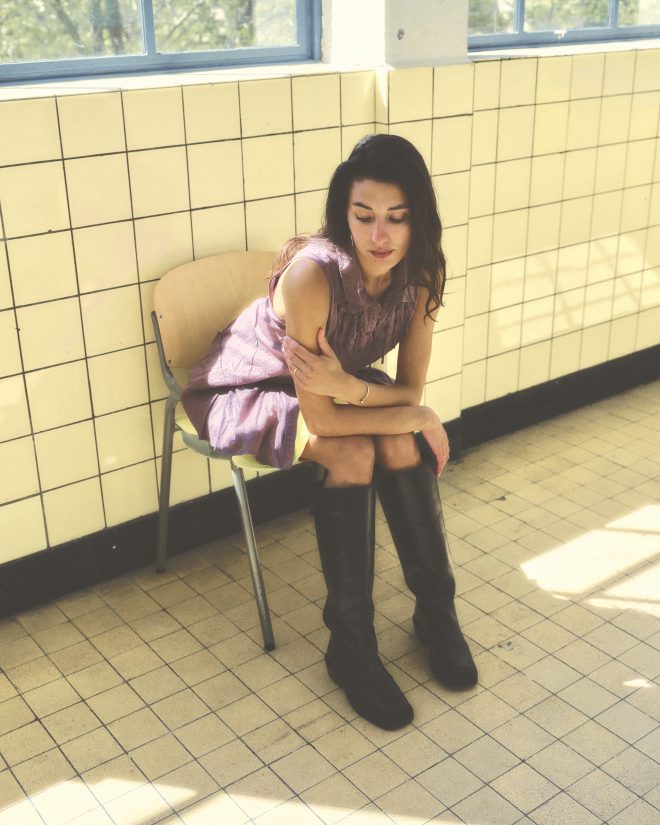
“My mind has always made strong visual connections. I often could only understand music theory once I could relate it visually.”
Looking ahead, she hopes to expand both her international touring schedule and the scope of her artistic projects. Plans include developing more ambitious live performances, potentially staged in unusual venues such as churches or theaters where music, visuals, styling and dance can converge into a single immersive experience.
Sensa, the newest chapter of her artistic journey, will also continue evolving. Khaldi has begun taking guitar lessons with the goal of eventually performing the project live with a band, adding yet another dimension to her already multifaceted career.
What remains constant across all these directions is a commitment to creative freedom. Khaldi hopes to maintain the ability to move fluidly between genres and formats without feeling constrained by industry expectations.
“My heart is in many different areas, and I hope I can continue to give myself the space to express all of them.”
In a music culture that often demands clear branding and predictable sonic identities, Kyra Khaldi represents a different philosophy. Her career unfolds not along a single straight line but across a constellation of projects, sounds and artistic languages. Rather than choosing one path, she continues to explore them all, trusting that the connections between them will gradually reveal a larger story.
